
Keyword Research Markets: Match Geography to the Customer You Can Serve
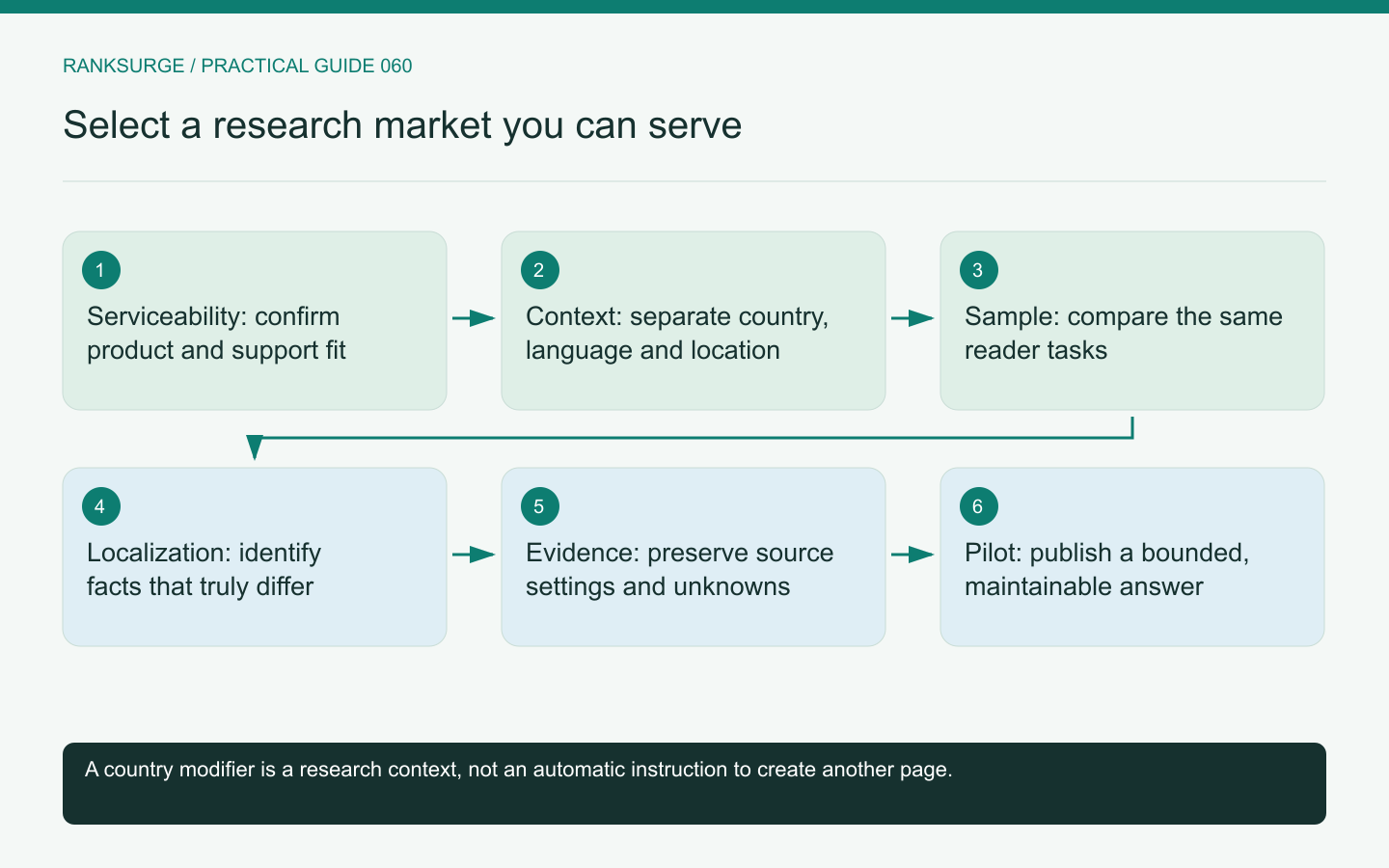
Select keyword research markets using customer serviceability, language and search context, then separate genuine local needs from duplicate country pages.
TL;DR
- Select a keyword-research market based on where the product can actually support customers, not on the largest reported numbers — prioritize operational capacity, billing and language before treating demand as decisive.
- Document the explicit context and compare like with like: record country, language and location, define the decision, and collect comparable query samples under documented settings.
- Validate the choice with a small, owned pilot and a named maintenance owner so assumptions are testable and revisitable rather than producing many thin, stale pages.
Choose a market the business can actually serve
A keyword research market should reflect where the product can support a customer, not simply where a tool reports the largest number. Start with service availability, language support, billing constraints and the operational capacity to help the intended audience.
For an illustrative business selling appointment software, a country with substantial reported demand may still be a poor immediate target if the product cannot support local payment requirements or customer support hours. Research can inform future expansion, but current content should not imply unsupported availability.
Write the serviceability assumptions before comparing demand. This keeps the selection grounded in a real commercial decision.
Separate country, language and location
A country is not a language, and a language does not identify one country. Record both explicitly in the research plan. For local tasks, the location within a country may also matter.
A Spanish-language query from one market can imply different services or expectations from the same wording elsewhere. An English-language software query can be globally understandable while still producing different result sets and commercial options by location.
Do not mix these contexts in one undifferentiated volume column. The source configuration is part of the evidence and should travel with the metric into the brief.
Start with one decision and comparable samples
Define what the market comparison is meant to decide: which audience to research first, whether to localize an existing resource or whether a product expansion deserves further validation. Then collect comparable query samples under documented settings.
For example, a team might examine the same small set of appointment-reminder tasks in two serviceable markets. It should compare the reader needs, current result types and product fit as well as reported demand.
This is more useful than comparing unrelated “top keywords” lists, where differences may come from the seed selection rather than the markets themselves.
Inspect the language of the actual task
Literal translation can miss the vocabulary customers use. Review current results and relevant first-party resources in the target language. If the team lacks the language expertise to assess nuance, involve a qualified reviewer before turning the research into publishable copy.
A translated phrase may describe a different product category or an informal expression rather than the intended business task. Preserve alternate phrasings during research, but do not create a page for each wording without checking whether the reader decision differs.
The objective is an understandable answer for the market, not a spreadsheet that contains translated versions of every source keyword.
Decide whether localization changes the content
A separate market page is justified when the reader needs materially different information and the team can maintain it. Availability, supported workflows, currency explanations or jurisdiction-specific requirements may change the answer, but those claims require appropriate evidence.
If the same guide serves both audiences accurately, one clear page may be sufficient. Adding a country name to identical copy does not by itself create a useful local resource.
Google's multi-regional site guidance describes approaches for sites serving different regions and languages. Use it when planning a real localization structure, alongside the editorial question of what must actually differ.
Keep estimates in their measured context
Record the data provider, query, country or location, language where applicable and collection date. If a provider does not support the requested combination or returns an unavailable value, preserve that limitation.
Do not add market estimates and label the result a precise global audience without understanding the methodology. Avoid interpreting a smaller reported number as proof that a market is commercially inferior; conversion suitability and service capacity are separate questions.
RankSurge's keyword research workflow can support the investigation. The decision record should still explain the selected context and why it matches a customer the business can serve.
Related reading: SEO for Startups: A Founder’s Handbook.
Related reading: Ranking for the Wrong Half of Your Audience.
Run a bounded first-market plan
Select a limited set of distinct pages or improvements for the first market. Define the factual review, language review and maintenance owner before expanding the calendar.
For the scheduling example, the initial work might include one supported workflow explanation and a localized pricing clarification. The team can then inspect whether users understand the offer and whether the content is operationally maintainable before multiplying the approach.
A bounded plan makes incorrect assumptions easier to correct. It also prevents an ambitious country matrix from becoming a large collection of thin, stale pages.
Revisit the choice when the product changes
Keep a named owner for the selected market assumptions. A translated page can remain technically available after its underlying support or billing promise becomes outdated, so the maintenance record must cover commercial facts as well as language quality.
Market research is tied to current capability. A new integration, support arrangement or billing option can make an earlier deferred market worth revisiting. Keep the original reasons so the team knows what has changed.
The best market choice is not necessarily the one with the biggest metric. It is the one where a clear reader need, credible product fit, appropriate language and maintainable evidence support a useful page and a serviceable customer relationship.