
Keyword Research for an Existing Site: Start With the Pages You Already Have
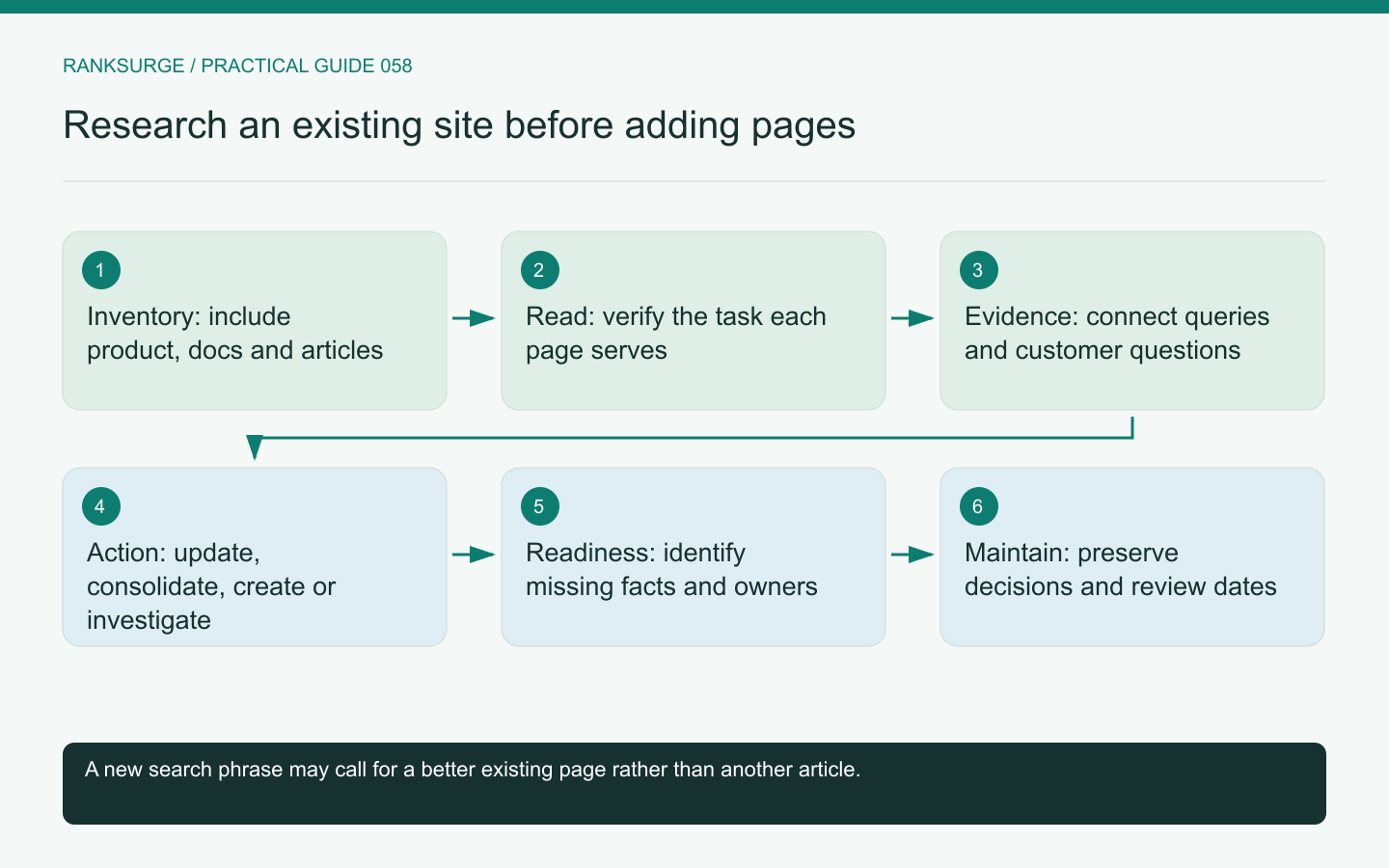
Research keywords for an established site by mapping current page purposes, customer questions and performance evidence before commissioning more articles.
TL;DR
- for keyword research on an existing site, begin by inventorying published pages and assign each discovery a concrete editorial action rather than treating new search phrases as automatic publication prompts.
- inspect representative pages, link the inventory to first‑party search and customer question evidence, and label opportunities so decisions reflect task fit and real demand signals.
- Meaningful limit and success check: mark evidence gaps versus writing gaps, prioritize by usefulness and readiness, and finish with owner assignments and review dates so improvements remain verifiable and maintainable.
Begin with the content you already own
Keyword research for an existing site should start with an inventory, because a new search phrase is not necessarily a new content need. The site may already have a suitable page that lacks one important answer, uses unclear language or has become difficult to discover.
Collect the published destinations and record their current purpose. Include product pages, documentation and important support resources as well as blog posts. A research process limited to the blog can miss the page that is best equipped to satisfy a commercial or implementation query.
Read a representative set before classifying everything
Titles and metadata are useful for an initial scan, but they can misrepresent the actual content. Read a sample from each major area and inspect pages that appear to overlap. Note where the title promises more than the body delivers or where a useful answer is hidden inside a broadly named article.
For an illustrative invoicing product, a page called “Getting Started” may contain the strongest explanation of recurring invoices. That discovery can change the research plan from “write another guide” to “make the existing explanation a clear destination.”
Record uncertainty when you have not yet inspected a page. An automated inventory is a starting point, not a completed editorial review.
Add first-party search evidence
Connect the inventory to page and query data from the Search Console performance report. Look for pages that already attract relevant searches, queries whose intended answer is unclear and important destinations with little observable search exposure.
Keep dates, markets and filters consistent when comparing records. Do not rank pages by clicks alone. A narrowly focused pricing or setup page can have a different role from a broad educational guide, so their success criteria should reflect the task they serve.
Also retain the distinction between an absent query row and a measured zero. The available report is evidence about its own scope, not a complete census of every possible search.
Related reading: The Dark Query Problem: Why Search Console Hides Most of Your Searches.
Bring customer language into the map
Review appropriate, authorized sources of customer questions: support themes, sales notes and product feedback. Remove personal details before turning them into editorial briefs. The aim is to identify recurring decisions and misunderstandings, not publish individual customers' situations.
Suppose several prospects ask whether invoices can be approved before delivery. Search-volume data might be unavailable for the exact wording, but the question can still expose a gap in a product page or workflow explanation.
Label the evidence honestly. “Repeated sales question” is different from “high-volume search query.” Both can justify useful content, but they should not be presented as the same kind of demand measurement.
Assign a specific action to each opportunity
Use a small set of editorial actions: retain, update, expand, consolidate, create or investigate. Attach each action to an existing destination whenever one already serves the task.
For example, “recurring invoice approval” could expand an existing workflow page with a concrete decision sequence. “Invoice export formats” might belong in documentation. A comparison between invoice automation approaches may justify a new buyer's guide if the site has no equivalent answer.
This action column is where research becomes useful. A list of hundreds of phrases without destination decisions merely transfers the uncertainty to the writers.
Distinguish an evidence gap from a writing gap
Sometimes the team knows what to write but cannot yet substantiate it. A proposed compliance comparison may require product, security or legal review. A performance claim may require actual measurements. Mark those dependencies before scheduling the page.
Do not fill an evidence gap with confident generic copy. Google's helpful-content guidance provides a useful quality reference, but the team must still produce the specific information the reader needs.
If a useful explanation can be written without the unresolved claim, narrow the brief explicitly. A smaller accurate page is preferable to a broad promise that the product cannot support.
Prioritize by expected usefulness and readiness
Compare the importance of the reader task, the strength of existing evidence, the effort required and the suitability of the destination. Reported search demand is one input, not the whole decision.
An existing comparison page with a missing limitation may be a better immediate project than an entirely new broad guide. The improvement can be clearly specified and reviewed. Another topic may deserve a new page because no current destination can answer it without losing focus.
Keep the rejected or deferred ideas with reasons. Future research can reuse those decisions rather than repeatedly rediscovering the same unsupported topics.
End with a maintenance plan
The final deliverable should connect queries to page actions and owners. Add a review date appropriate to the material: changing product capabilities and pricing need different attention from stable conceptual explanations.
RankSurge's keyword research workflow can support the evidence collection. The editorial value comes from making the site's existing knowledge easier to use and identifying genuinely missing answers, rather than treating every keyword export as an instruction to publish more pages.
Related reading: SEO for Startups: A Founder’s Handbook.