
Keyword Difficulty Scores: Use Them as a Screening Signal, Not a Verdict
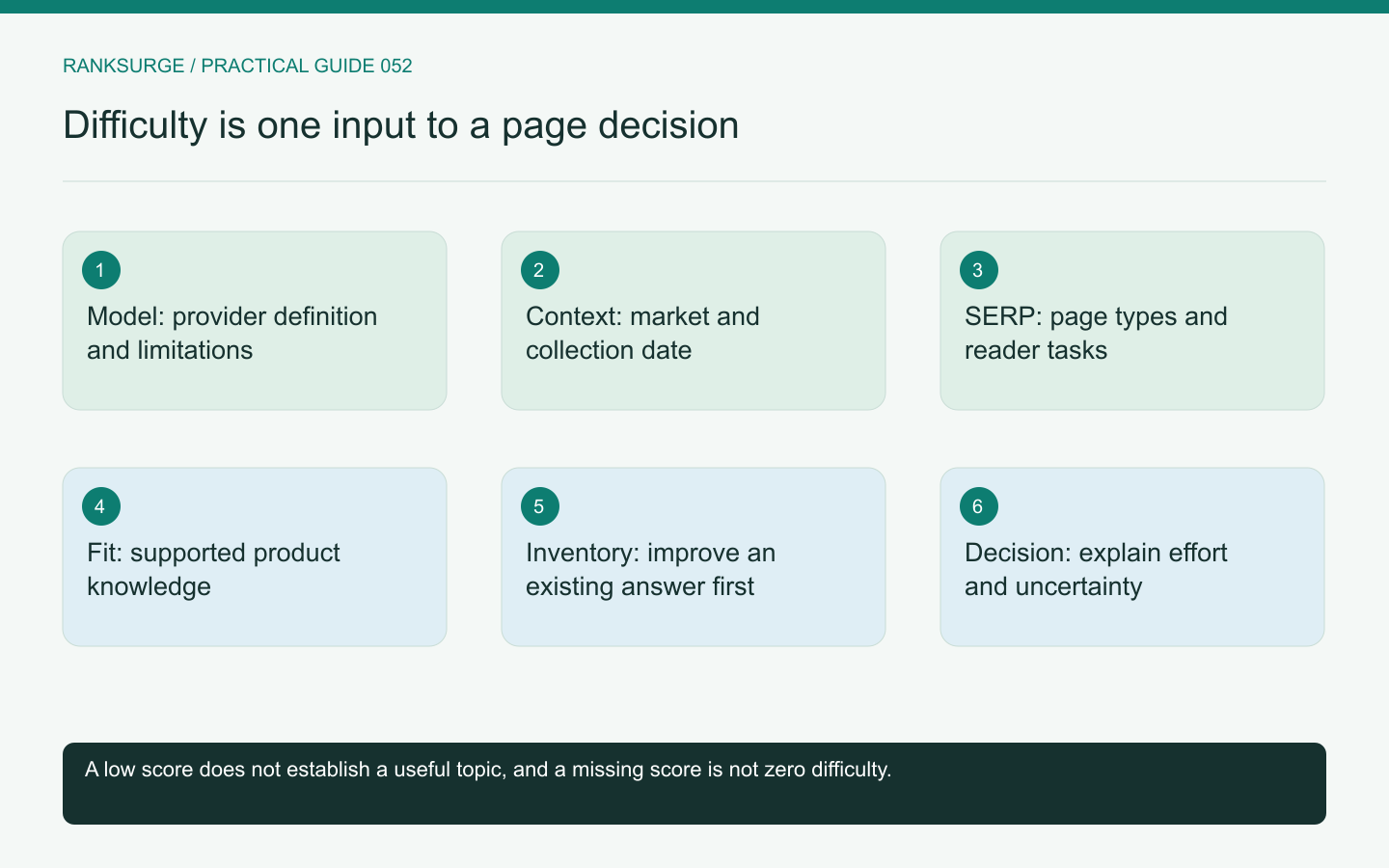
Use keyword difficulty scores as a screening tool while reviewing the actual search results, product fit and evidence needed for a useful page.
TL;DR
- Treat keyword difficulty as a tool's model output and a screening signal—not a verdict—so record context and avoid treating the number as a direct command to accept or reject a topic.
- Use difficulty scores pragmatically to triage effort: sort large backlogs, prioritize investigation, and inspect representative SERP pages and page types before deciding whether to create or update content.
- Log uncertainty and check outcomes: keep the original score and research context as a planning record, mark unknowns rather than assigning zero, and revisit the model after publication.
Treat the score as a model output
Keyword difficulty is a tool's estimate of how challenging an organic search opportunity may be under its methodology. It is not a direct measurement of your future ranking and not a command to accept or reject a topic.
Start by recording the provider, market and collection date beside the score. A number without that context is easy to compare incorrectly. Two products can use similar labels and scales while calculating them from different inputs.
Read the provider's definition
Ahrefs describes its keyword difficulty model in relation to referring domains of highly ranked pages and notes limitations in what the measure includes. Other tools use their own models. Read the definition before treating a score as a complete representation of the search result.
Do not average scores from different providers as though they were repeated measurements from the same instrument. The result may look precise while having no clear interpretation.
A useful research table can retain both values separately with their source names. The disagreement becomes a reason to inspect the underlying opportunity, not a problem to hide through arithmetic.
Use the score to allocate review effort
A difficulty measure can help sort a large backlog into groups for further investigation. It can suggest that some queries deserve a closer look at established competitors or that others may be worth an initial content review.
Avoid a universal rule such as publish everything below a chosen number. A low-scored query may have poor product fit, weak demand or a result format your site cannot satisfy. A higher-scored query may still be central to explaining the product to customers.
The useful action is proportional review. Spend more effort understanding the opportunities that combine business relevance with uncertainty, rather than letting the score replace that judgment.
Inspect the actual result pages
Open representative results for the query in the relevant context. Identify the page types, the reader tasks they address and the evidence they provide. A score cannot tell you whether the results are mostly product categories, official documentation, calculators or broad editorial lists.
For an illustrative technical query, official documentation may dominate because the user wants a definitive reference. A generic blog post may be a poor answer even if its author can obtain more links. The content format and authority needed for the task matter.
Record the observed URLs and your interpretation. RankSurge's keyword research workflow can support metric and SERP review, but the page decision still requires explicit reasoning about the reader's need.
Related reading: SEO for Startups: A Founder’s Handbook.
Related reading: How to Use Vellum and OpenSEO for Your SEO Engine.
Compare the opportunity with your existing page
Before planning a new article, inspect whether the site already answers the question. A difficulty score applies to a query-level estimate; it does not tell you whether an existing page has useful history, relevant evidence or a missing section that can be improved.
Use a fixture with one existing comprehensive guide and one truly uncovered task. The first may justify a focused update, while the second may justify a new page. Treating both as new-content opportunities creates unnecessary work and possible overlap.
Also examine whether the product can substantiate the proposed answer. Strong product fit does not guarantee ranking, but absent fit is a good reason to reject a misleading brief regardless of the score.
Keep uncertainty in the priority record
A useful shortlist can include difficulty, reported demand, commercial relevance, content readiness and confidence in the proposed page. Do not collapse every dimension into a complicated formula unless the team can explain what the formula is meant to decide.
For example, a narrow customer problem with unavailable difficulty can still deserve documentation. Mark the score unknown and justify the work through the customer task. Do not assign zero to make it look easy.
Conversely, a measured low score should not make an unsupported claim acceptable. The quality and truthfulness of the page remain independent requirements.
Revisit the model after publication
Keep the original score and research context as a historical planning record. Later, compare the actual outcome with the expectations the team formed, while recognizing that many factors changed during the period.
The aim is not to prove that a provider's score was right or wrong from one page. It is to improve how your team uses the signal. Perhaps the score was useful for broad triage but weak for a particular technical category or local market.
Explain the decision in ordinary language
A good final recommendation can say: this topic fits our product, the results suggest a comparison page, our current page lacks one important decision and the difficulty signal warrants a modest initial investment.
That explanation is more useful than “the score is low.” Keep keyword difficulty in the workflow as one input that directs attention. The page should be selected because the complete evidence supports a useful answer your team can create and maintain.