
Keyword CPC and Buying Intent: Check the Search Result Before Drawing a Conclusion
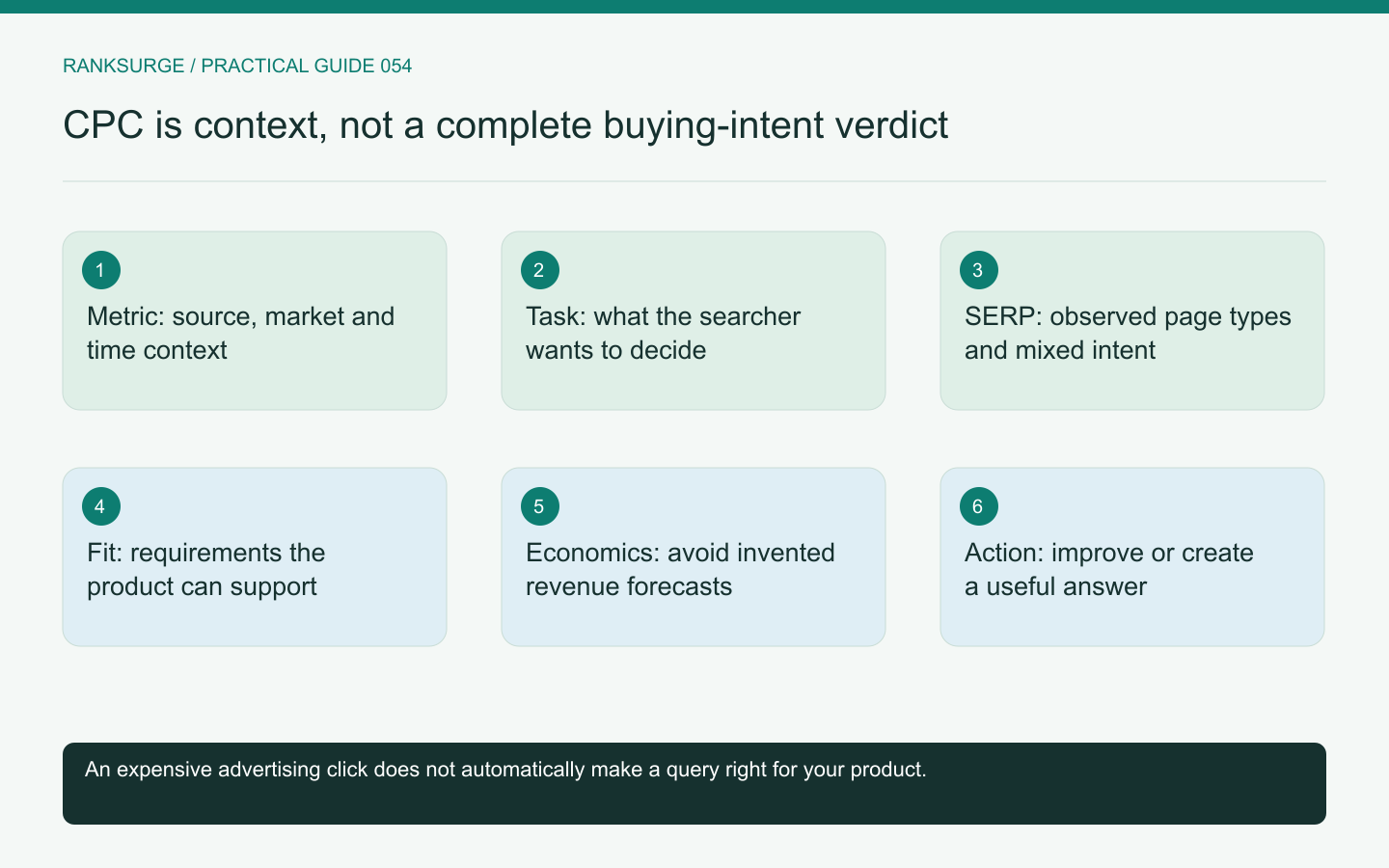
Use keyword CPC as advertising context while checking organic search intent, customer fit and the page decision your product can support.
TL;DR
- Main decision: treat CPC as a signal, not proof—it can imply advertiser interest but does not prove searchers are ready to buy or show organic ranking difficulty.
- Useful method: translate queries into explicit customer decisions and inspect current search-result formats to test that hypothesis before committing content resources.
- Meaningful limit/success check: avoid turning CPC into a revenue forecast; instead use observed intent, product fit and documented evidence to justify publishing or investment.
Separate advertiser behavior from reader intent
Keyword cost per click can suggest that advertisers value traffic associated with a query. It does not directly establish that every searcher is ready to buy your product, nor does it measure how difficult an organic page will be to rank.
Start by labeling the source and meaning of the CPC figure. An estimate, a historical value and a forecast are different kinds of evidence. Keep the market and date context alongside the number instead of treating CPC as a universal property of the phrase.
Read the metric in its advertising context
Google's Keyword Planner forecast documentation explains forecast behavior in a paid-search planning context. SEO tools may present related advertising metrics as part of keyword research, but their presence does not turn them into organic conversion predictions.
Semrush's Keyword Overview documentation distinguishes several research measures, including CPC and intent-related information. Keep those dimensions separate in your own planning table rather than allowing one attractive number to stand in for the entire opportunity.
A high CPC can be a useful prompt to investigate. It should not be the final reason a topic receives a content budget.
Translate the query into a customer decision
Ask what the person typing the phrase is trying to accomplish. They may be comparing vendors, solving a problem, navigating to an existing account or researching a concept before any purchase is plausible.
For an illustrative software category, “invoice software pricing” suggests a different task from “invoice template meaning.” Both may attract advertisers, but the appropriate organic page and product handoff can differ substantially.
Write a one-sentence interpretation and mark it as a hypothesis until you inspect the results. This prevents the team from quietly treating its preferred commercial interpretation as established fact.
Inspect the current search-result format
Review representative results in the relevant market. Identify whether the visible pages are product pages, comparison guides, free tools, definitions or official references. Look for mixed intent rather than assuming every result serves one uniform task.
A query with a valuable advertising market may still have organic results dominated by a free utility. If your product cannot provide a useful version of that experience, a generic buying article may be a weak fit.
RankSurge's keyword research tools can support metric and SERP inspection. Preserve the observed URLs and the reasoning behind the page choice so another reviewer can challenge it without repeating the whole investigation.
Related reading: SEO for Startups: A Founder’s Handbook.
Related reading: The Dark Query Problem: Why Search Console Hides Most of Your Searches.
Compare commercial fit with capability fit
A query can be commercially attractive and still describe a product you do not sell. A hosted service should not publish an installation tutorial implying an unsupported self-hosted edition just because related advertising clicks appear expensive.
Record the supported customer requirements and the limitations your page would need to disclose. An honest comparison may be appropriate; an overstated product landing page is not.
This distinction also helps prioritize content. A moderate-CPC query closely tied to a useful supported workflow can be more relevant to your business than a high-CPC category where your offering is only tangential.
Avoid converting CPC into a revenue forecast
Multiplying estimated organic traffic by CPC does not establish the revenue a page will generate. The calculation combines a paid-market price with an uncertain organic audience and ignores the product's actual conversion and customer economics.
You can use such a calculation as a clearly labeled advertising-value illustration if it serves a specific discussion, but do not present it as expected sales or profit. For content prioritization, it is often clearer to describe the customer decision and the product value directly.
If the team needs a financial forecast, build it from explicit assumptions and actual business data with the appropriate owners. A keyword table alone cannot supply those inputs reliably.
Keep low and unknown CPC in perspective
A low or unavailable CPC does not prove a topic has no business value. A narrow technical question can help existing customers succeed, reduce repeated support work or establish a useful product capability even when advertising evidence is weak.
Conversely, a high CPC does not justify ignoring duplicate coverage. Review existing pages before commissioning a new one. The right action may be an update that better answers the buying question rather than another article targeting a slight wording variant.
Keep unknown metrics unknown. Do not manufacture a paid-market estimate merely to make every row sortable by the same numeric formula.
Use CPC to ask a better next question
A good research conclusion might say: the advertising signal suggests commercial interest, the results show buyers comparing deployment options and our product can support an accurate comparison with clear limits.
That is a stronger basis for work than “the CPC is high.” Use the metric to direct attention, then make the page decision through observed intent, product fit and the evidence your team can provide. The reader's task remains the reason to publish.