
Keyword Clustering Software: Compare the Page Decisions Behind the Groups
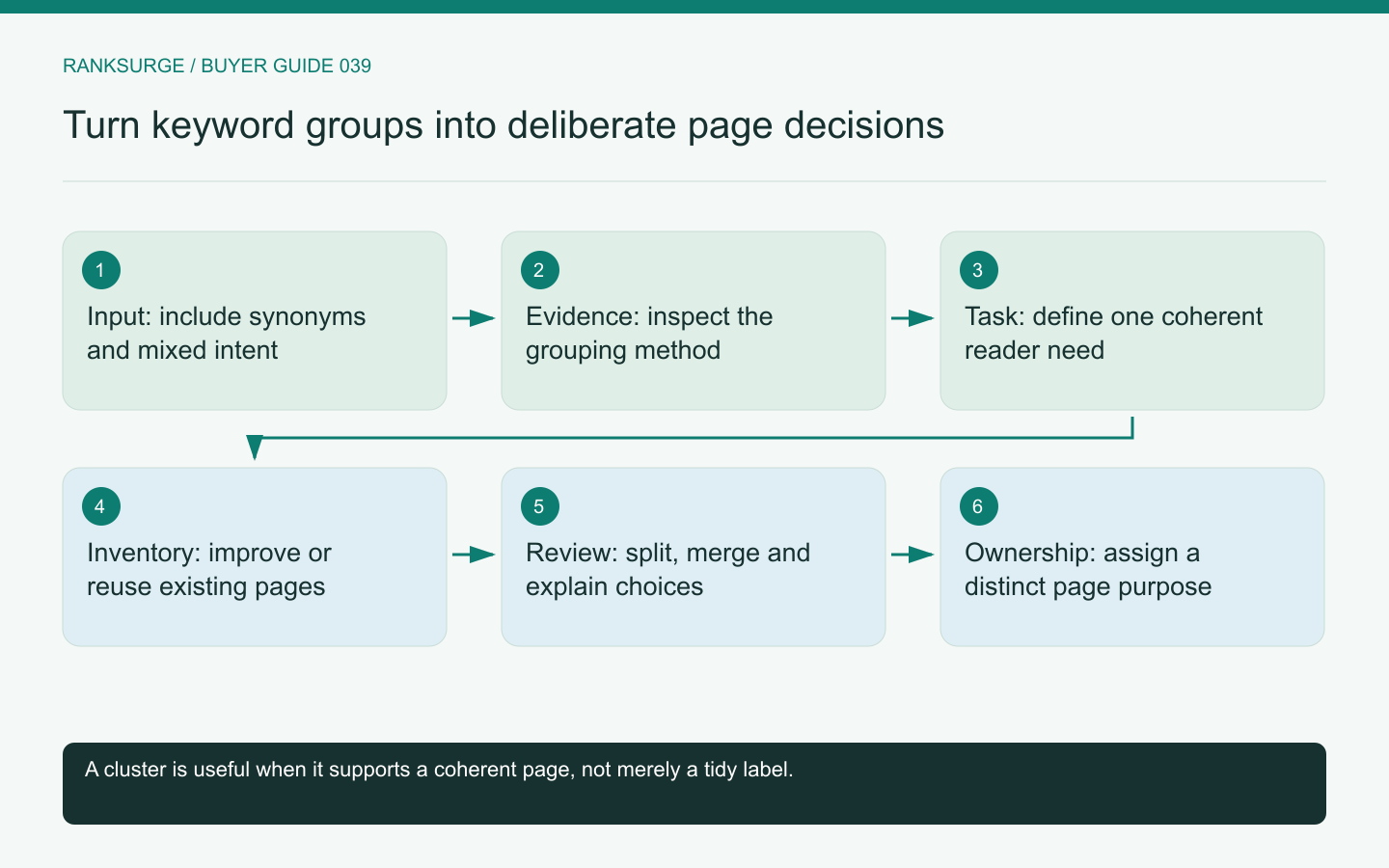
Compare keyword clustering software by testing page decisions, mixed intent, existing-page coverage and the evidence behind proposed groups.
TL;DR
- Decide on page plans rather than cluster counts: treat clustering as a tool to determine which queries belong on one useful page and which require separate treatment, not as the final objective.
- Evaluate methods and evidence during trials: start with a modest, deliberately difficult keyword set and ask what evidence supports each proposed group, including how location or language settings affect analysis.
- Measure success by defensible page ownership and distinct reader tasks: prefer tools that produce a few pages the team can clearly describe, each with a distinct purpose and relationship to existing content.
Judge the page plan, not the cluster count
Keyword clustering software is valuable when it helps a team decide which queries belong on one useful page and which require separate treatment. Producing neat groups is not the final objective. A beautiful cluster can still combine incompatible reader needs or split one clear answer into several unnecessary articles.
Start the buying trial with a modest, deliberately difficult keyword set. Include close synonyms, a broad category term, a troubleshooting query, a buying comparison and terms already covered by your site. The tool should help explain the resulting page decisions, not merely assign every row a label.
Ask how the grouping was produced
Some tools emphasize wording similarity; others use observed search-result overlap or a combination of signals. Ask what evidence supports each proposed group and how location or language settings affect the analysis.
Semrush's Keyword Strategy Builder documentation describes its topic and page planning workflow. Use such documentation to understand the candidate's model, then test it against the decisions your own site needs to make.
No grouping method removes editorial judgment. Search results can change, broad queries can contain mixed intent and your product may serve only part of a topic. The software should make disagreement manageable instead of treating its first grouping as an unquestionable site architecture.
Use a mixed-intent example
Consider an illustrative list containing email API pricing, email API authentication and email API not sending. All share the same product-category words, but a buyer comparing costs has a different task from a developer diagnosing a failure.
Ask the candidate to show why it combines or separates those terms. Then inspect representative search results and define what a single page would need to answer. If the proposed page would become an unfocused collection of unrelated sections, the grouping needs review.
The reverse mistake is equally important. Several close phrasings of one purchasing question may belong on the same comprehensive page. A tool that turns each wording variant into a separate article plan can create avoidable overlap and maintenance work.
Include existing pages before approving new ones
Import or review your current page inventory alongside the keyword groups. The relevant decision may be to improve an existing page, merge overlapping material or create a new page. New content should be one option, not the automatic output of every cluster.
Use a fixture in which an existing guide already answers most of a proposed cluster but lacks one important comparison. Ask whether the workflow supports a targeted update. A plan that ignores the existing guide and commissions a replacement has not solved the editorial problem.
RankSurge's MCP documentation includes keyword research and saved project context that can support this review. Verify the actual clustering workflow you intend to use; do not assume saved keywords themselves constitute an automatic page-planning engine.
Related reading: SEO for Startups: A Founder’s Handbook.
Related reading: The Dark Query Problem: Why Search Console Hides Most of Your Searches.
Compare aggregate metrics carefully
A cluster's summed volume can be useful context, but related queries may not represent independent groups of people. Do not interpret the sum as a guaranteed unique audience or a traffic forecast.
Ask whether the tool preserves the component metrics and their market context. If a high-volume broad term dominates the group, the proposed page may look more attractive than its narrower commercial purpose warrants. Review the terms that actually define the page's scope.
Unknown values should remain visible. A cluster containing several unmeasured technical queries should not appear precisely quantified just because the software fills blanks with zeros or estimates without explanation.
Test editing and repeatability
Move one keyword to another group and split a mixed-intent cluster. Determine whether the tool preserves your reasoning and whether a later refresh overwrites those decisions. Human review should be part of the saved plan, not temporary work lost on the next run.
Ask another editor to inspect the revised grouping without attending the original discussion. They should understand the intended page, the keywords it covers and the reason certain terms were excluded.
Also record the input set and analysis context. If the tool is run again with different keywords or a different market, a changed cluster count does not necessarily indicate improved or degraded research.
Give every approved page a named owner and one sentence describing its distinct purpose. This helps future editors resist adding adjacent queries that would weaken the page’s scope.
Choose software that supports deliberate page ownership
A spreadsheet may be sufficient for a small list with strong editorial knowledge. A clustering platform can save substantial work when it supplies inspectable evidence and reliable revision handling. Compare the amount of review it removes without weakening the final decision.
The strongest trial ends with a few pages your team can describe clearly, each with a distinct reader task and a relationship to existing content. Buy the tool that makes that plan easier to defend. The number of clusters generated is only an intermediate output.