
Keyword Clustering: Map Searches to Reader Decisions Before Creating Pages
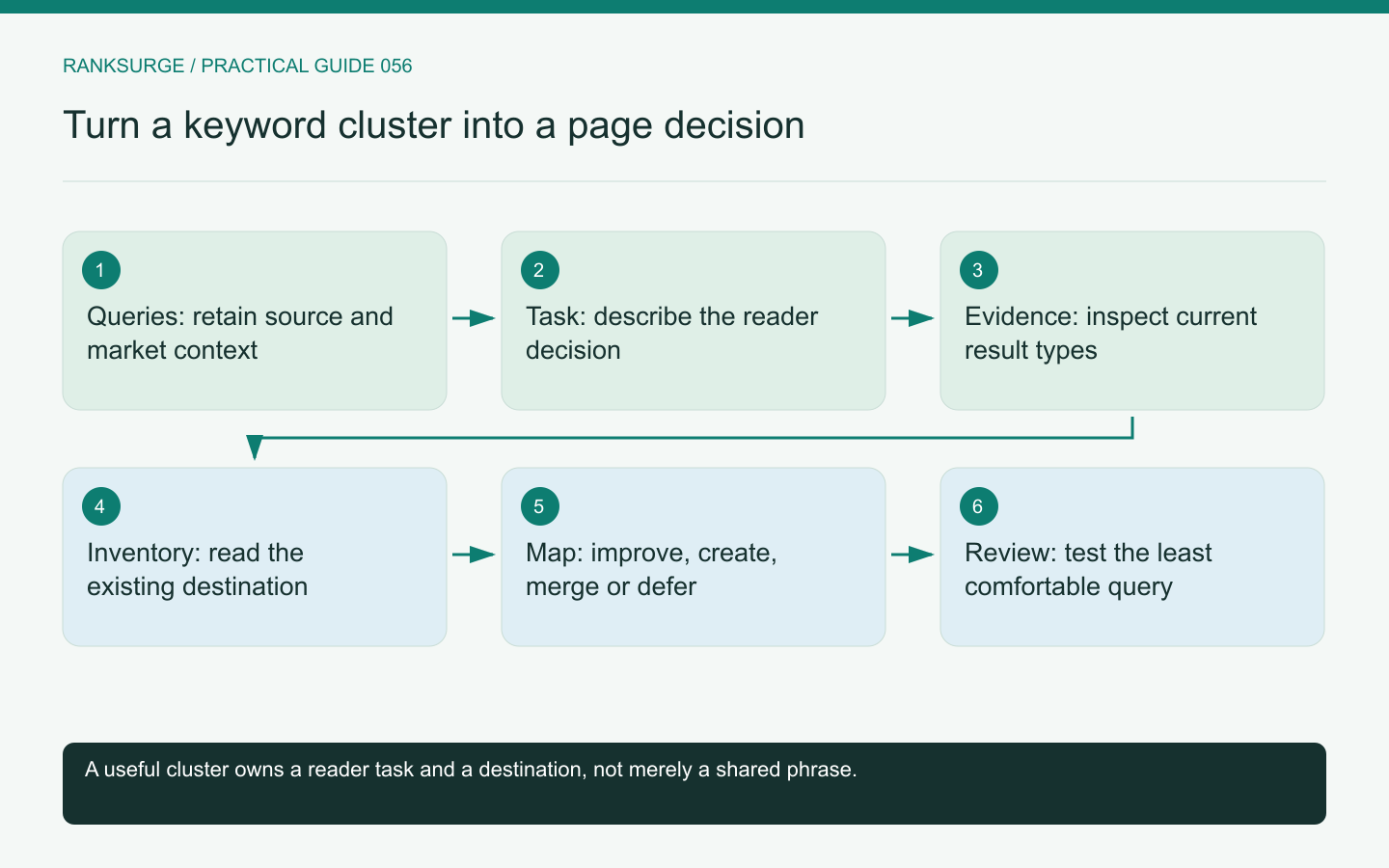
Map keyword clusters to distinct reader decisions, choose the right existing or new page and preserve exceptions before assigning writing work.
TL;DR
- Decide clusters by the page question they must answer: convert keyword groups into a single reader task to determine format, evidence and call to action before drafting pages.
- Map clusters into an actionable table assigning destination and next action, so researchers can choose to improve, create, merge or shelve pages and avoid duplicate drafts.
- Validate groupings with a counterexample test and ongoing evidence review: pick the least-comfortable query in each cluster and confirm the assigned page gives a direct answer and next step.
Make the cluster answer a page question
Keyword clustering becomes useful when it answers a practical question: which searches should one page satisfy? A group of phrases is not automatically an article brief. The phrases might describe different stages of a decision, or the site might already contain the best destination.
Start by writing the reader's task in one sentence. “Compare hosted monitoring tools before a trial” is a clearer task than “monitoring keywords.” The first statement helps determine the page format, required evidence and suitable call to action. The second only identifies a broad subject.
Preserve the original evidence beside the group
Keep the query, market, reported metrics, collection date and source even after assigning a cluster. A cluster label should add interpretation rather than replace the underlying observations.
Do not add search volumes mechanically and present the sum as a guaranteed audience. Closely related phrases may overlap in meaning, and the source may group some variations. A grouped demand figure needs a documented method and clear limitations.
RankSurge's keyword research features provide research context for this work. The analyst still needs to explain why a set of searches belongs to a particular page.
Related reading: The Dark Query Problem: Why Search Console Hides Most of Your Searches.
Related reading: SEO for Startups: A Founder’s Handbook.
Separate vocabulary overlap from task overlap
Consider these illustrative searches: “website monitoring software,” “website monitoring software pricing” and “website monitoring alert setup.” They share words but do not necessarily require the same answer.
A category buyer's guide could help with the first search. A transparent pricing page may best serve the second. Product documentation could serve the third. Combining all three into one long article may bury the answer each reader needs.
Conversely, “monitoring tool comparison” and “compare website monitoring services” may point toward the same buying decision. Different wording alone is weak justification for separate pages. Review current result types and the actual question behind each phrase.
Build a page map with explicit ownership
Use a table with a cluster name, reader task, primary destination, supporting queries and action. The action should be one of a few meaningful choices: improve an existing page, create a new page, merge redundant coverage or retain the idea for later research.
For a hypothetical monitoring company, the buyer-comparison cluster might map to an existing guide that lacks a clear selection matrix. The alert-setup cluster could map to documentation. A new compliance cluster might stay unassigned because the company cannot yet support the necessary claims.
Include a short exclusion in the map as well. The buyer guide might explicitly exclude installation troubleshooting, directing that task to documentation. This boundary helps a writer avoid turning a useful comparison into an unfocused encyclopedia and gives reviewers a concrete way to check whether the draft has drifted.
Give every proposed destination an owner. Otherwise a well-organized keyword sheet can still produce several competing drafts when different writers pick similar rows independently.
Allow exceptions inside a cluster
Some queries are close enough to research together but different enough to deserve separate destinations. A country-specific requirement, a platform limitation or a materially different buyer can justify an exception. Document the actual difference rather than relying on a geographic modifier alone.
For example, a page about monitoring a private internal service may need different architecture and security evidence from a general public-site comparison. If the product cannot support private services, the right action may be exclusion rather than another article.
Keep an exception note beside the query. This prevents a later automated clustering pass from silently undoing a useful editorial decision.
Check the existing destination before creating a brief
Read the candidate page, not just its title. Look for the task it actually solves, its scope and the evidence it already contains. A broad title can hide a narrow article, while a narrow title can sit above a comprehensive answer.
Write the smallest useful change. Perhaps the page needs a worked example, a missing limitation or a better explanation of who should choose each option. A focused improvement can resolve a cluster without creating a new URL.
Google's helpful-content guidance emphasizes useful content for people. Use that as a quality constraint: the cluster should support a real answer rather than justify pages for every phrase variation.
Review the map with a counterexample
Before approving the map, choose a query that seems least comfortable in each group. Ask whether a reader arriving with that query would find a direct answer and an appropriate next step on the assigned page.
If the answer requires a long explanation about why the page is “close enough,” revise the grouping. This quick counterexample test catches clusters that look tidy in a spreadsheet but mix incompatible needs.
After publication, retain the mapping and revisit it using page and query evidence. The goal is not a permanently perfect taxonomy. It is a clear, maintainable agreement about which page serves which decision and why.