
Keyword Cannibalization: Diagnose Competing Pages Without Blaming Every Overlap
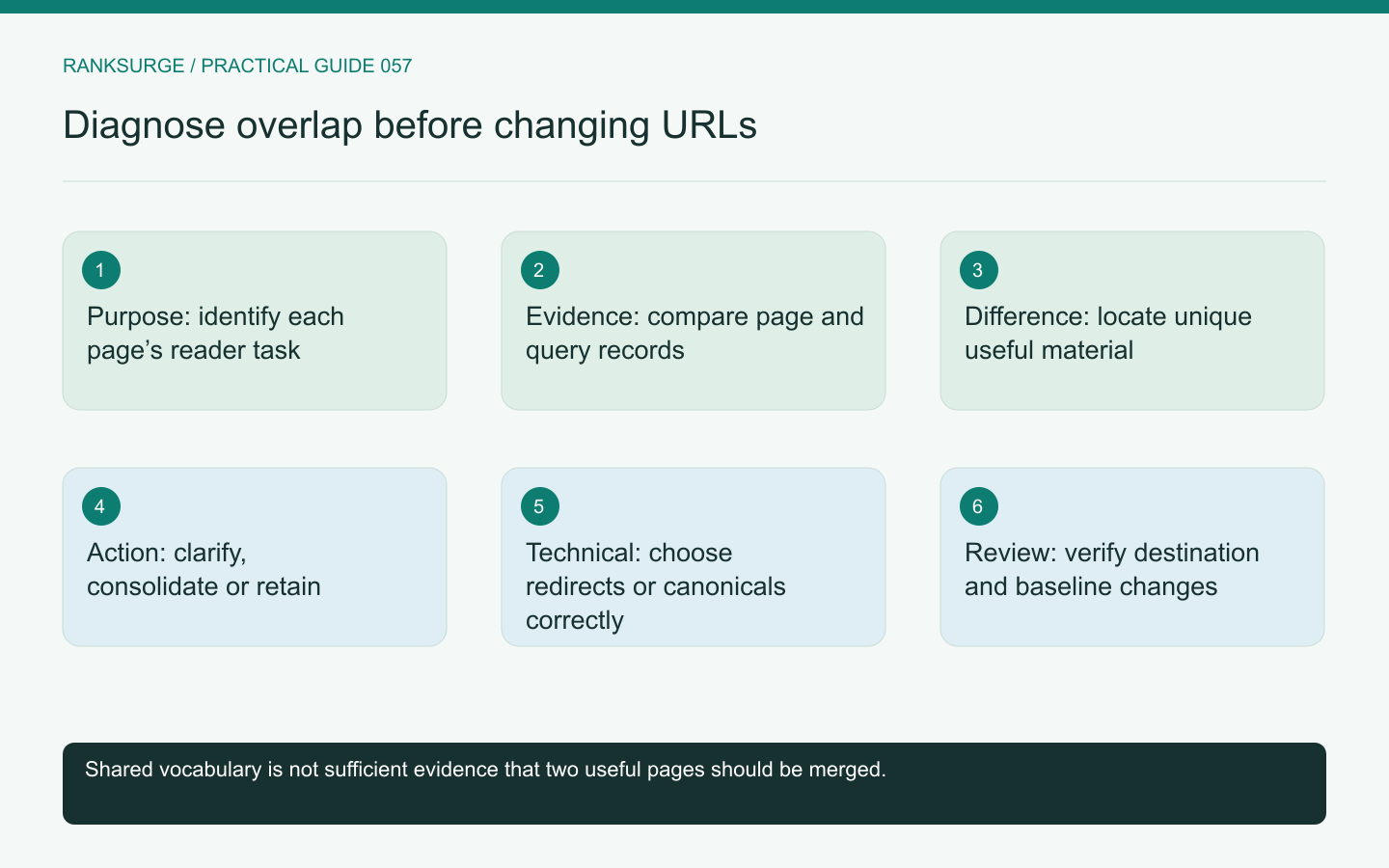
Diagnose keyword cannibalization by comparing page purposes, query evidence and landing-page behavior before merging or redirecting useful content.
TL;DR
- Decide against assuming cannibalization: treat overlapping search results as a question about page purpose and user outcomes, not an automatic verdict that pages must be removed or merged.
- Diagnose by documenting each URL’s intended job and checking query-level behavior with first-party data, so decisions rest on audience, reader task, and performance evidence rather than keyword counts alone.
- Limit changes to the smallest justified intervention, record a baseline, and confirm outcomes so consolidation or redirects preserve unique evidence and yield a clearer site with distinct page jobs.
Treat overlap as a question, not a verdict
Two pages appearing for related searches do not automatically prove keyword cannibalization. A site can legitimately have a product page, a comparison guide and implementation documentation about the same subject. The important question is whether their purposes are clear and whether users reach a useful destination.
Start with a specific concern. Perhaps the wrong page repeatedly attracts an important query, or two nearly identical guides alternate without a clear owner. “Several pages mention the keyword” is too broad to justify deleting or merging anything.
Write the intended job of each page
Create a short record for every candidate URL: audience, reader task, primary conversion or next step, and the distinct evidence the page supplies. Read the body and inspect the actual experience rather than inferring its purpose from the slug.
For an illustrative analytics product, a product page might explain capabilities and trial access. A comparison guide might help buyers evaluate competing approaches. A setup tutorial might help an existing customer connect a data source. Those are different jobs despite shared terminology.
If two guides cannot be distinguished without citing their publication dates, investigate further. Their difference may be historical rather than useful to a reader today.
Inspect page and query evidence together
Use first-party performance data to see which pages appear for the relevant queries and how that pattern changes over comparable periods. Google Search Console's performance report provides page and query dimensions for this investigation.
Keep the report's scope and filters in the notes. A single daily fluctuation is weak evidence for a structural problem. Compare enough context to separate an ongoing pattern from a short-lived change, and consider whether a site release or seasonal shift happened at the same time.
Do not treat every missing query row as proof that no one searched. Reporting constraints and the selected filters affect what you can observe.
Related reading: The Dark Query Problem: Why Search Console Hides Most of Your Searches.
Use a concrete two-page test
Imagine a site has “Choosing an Analytics Platform” and “How to Pick Analytics Software.” Both target small software teams, cover the same selection criteria and recommend the same next step. The second adds no meaningful evidence beyond a newer introduction.
That pair deserves a consolidation review. By contrast, “Analytics Platform Security Checklist” might support a separate procurement task with questions and evidence absent from the general guide. It should not be merged merely because both pages mention analytics software.
Write the distinction as a reader outcome. This makes the decision easier to review than a rule based only on matching headings or shared keywords.
Choose the smallest justified intervention
If the pages serve different tasks, clarify their titles, introductions, navigation and internal links. A reader should understand where each page fits. Strengthen the distinctive evidence rather than repeating the general guide inside every supporting article.
If the pages duplicate the same task, identify the stronger destination and plan what unique material should move. Evaluate existing links, user paths and technical behavior before implementing a redirect or removal. Preserve a record of the old destination and the intended replacement.
For the illustrative duplicate guides, list the unique examples from each before selecting a destination. If one contains a valuable procurement worksheet, preserve and update that worksheet in the retained answer. Consolidation should remove redundant navigation and repeated explanation, not accidentally discard the most useful part of the weaker page.
Do not combine pages solely because one currently receives fewer clicks. A low-volume page can still serve an important customer or support task that the other page cannot answer.
Keep canonicalization in its proper role
Google's canonicalization documentation addresses duplicate or very similar URLs and explains consolidation signals. It is not a general instruction to canonicalize any two articles that share a topic.
For genuinely different content, a canonical tag is a poor substitute for editorial clarity. First decide whether the pages should remain distinct. Then choose technical implementation appropriate to the actual relationship between them.
If a consolidation is approved, involve the person responsible for routing, sitemaps and internal links. An editorial decision is incomplete when visitors still encounter obsolete navigation or an unexpected destination.
Record a baseline and review the outcome
Before making changes, save the affected URLs, page purposes, relevant queries and the reason for the intervention. Afterward, inspect both technical behavior and user-facing results. Confirm the intended destination loads and the content actually answers the original task.
Performance changes will not isolate causation perfectly. Other site and search changes may occur during the same period. Report what changed and what remains uncertain instead of claiming that one cleanup definitively produced every improvement.
The useful outcome is a clearer site: each retained page has a distinct job, overlapping material is intentional, and redirects or removals have an evidence-based explanation. That is a stronger standard than eliminating every repeated keyword.
Related reading: SEO for Startups: A Founder’s Handbook.