
Hosted vs Self-Hosted SEO Tools: A Responsibility Worksheet
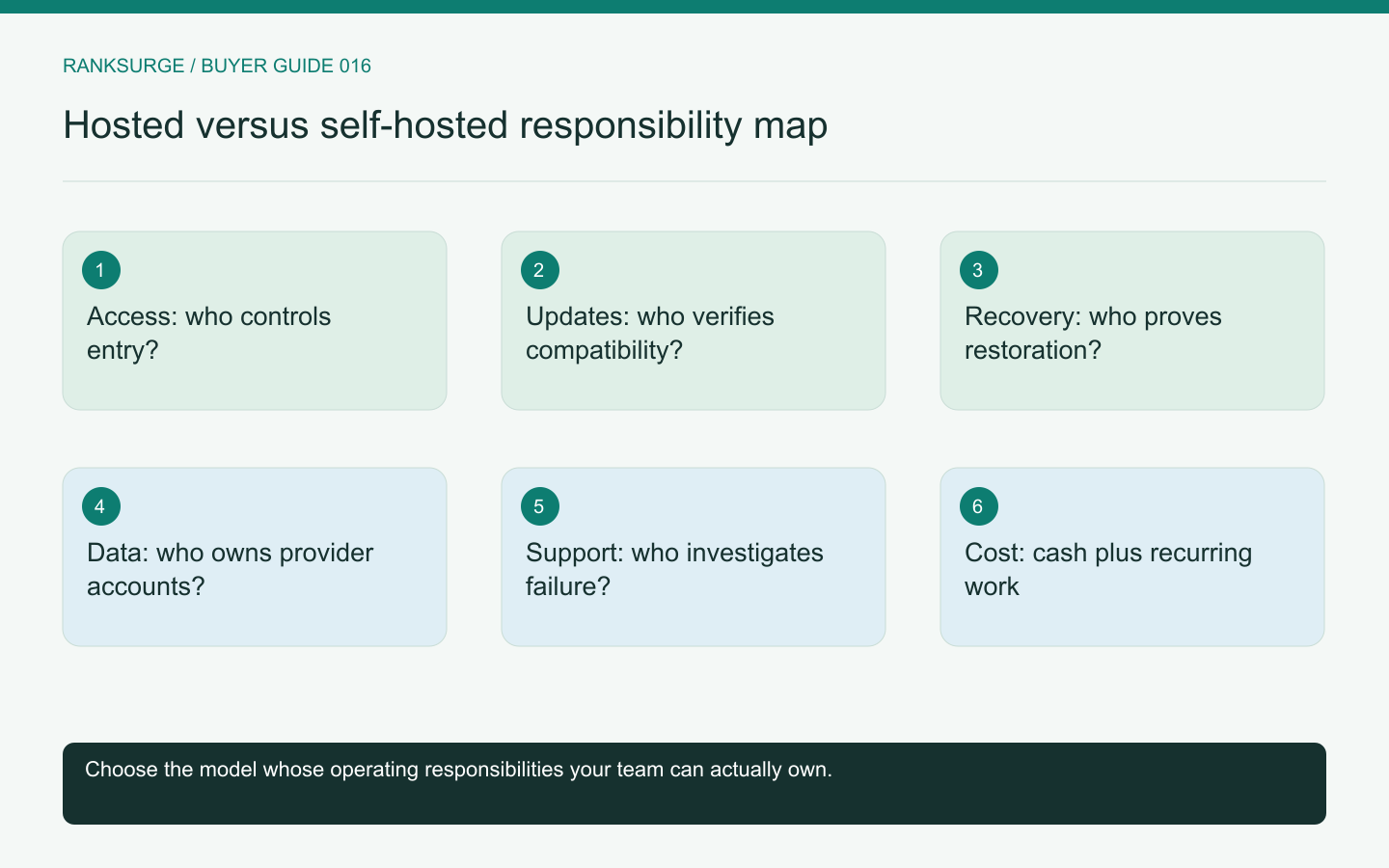
Compare hosted and self-hosted SEO tools with a responsibility worksheet covering data providers, access, updates, recovery and real operating cost.
TL;DR
- Decide between hosted and self-hosted SEO tools by assigning responsibilities, not by invoice alone; pick hosted if managed responsibility fits, or self-hosting when explicit control benefits justify assigned work.
- Use a responsibility worksheet as the primary method: list required research work, then name who performs each task for hosted and self-hosted options before comparing costs.
- Validate continuity and operability with a small exercise: export and restore representative projects, record time and gaps, and verify relationships and the ability to resume safe work.
Compare responsibility before comparing the bill
Hosted and self-hosted SEO tools can provide similar research capabilities while assigning very different work to your team. A hosted subscription usually packages an operated service. A self-hosted deployment gives you more direct control but requires someone to maintain the environment and its dependencies.
The decision should begin with a responsibility worksheet. List the work that must happen for research to remain available and trustworthy, then name who performs it under each option. A lower monthly invoice is not a complete cost comparison if it excludes the engineer who handles updates, recovery and provider configuration.
Avoid treating self-hosting as automatically private or managed hosting as automatically effortless. Evaluate the actual deployment and agreement.
Separate the software from the data supply
An SEO application may depend on external providers for keyword, search-result or backlink data. Running the interface on your infrastructure does not necessarily eliminate those relationships. Ask which accounts, credentials and usage charges remain necessary.
RankSurge's pricing page describes self-hosting with your own infrastructure and data-provider accounts. Use that distinction when comparing its managed and self-hosted options. The software deployment and the research-data bill are separate parts of the operating model.
For each required workflow, identify the source of the data, who pays for it and what happens when access expires or credit runs out. A healthy application can still return no useful research if an external dependency is unavailable.
Related reading: The Best Open Source SEO Tools in 2026.
Related reading: How to Prompt Claude Code for SEO.
Assign ownership for five recurring jobs
The first job is access management: inviting people, removing them and maintaining a safe authentication boundary. The second is updates: deciding when to adopt new versions and checking compatibility with stored data and integrations.
The third is recovery: taking usable backups and proving that a restored environment works. The fourth is observability: noticing failed jobs, broken connections or unexpected spending. The fifth is support: deciding who investigates when a researcher cannot complete a task.
For each job, write an actual person or team, not simply “IT.” If no one accepts a responsibility, that is an unresolved requirement. It should influence the purchase decision before the deployment becomes a shared dependency.
Work through a small-team example
Imagine a two-person consultancy that performs occasional audits. One person can deploy containers but neither wants to maintain an on-call service. Self-hosting may still be useful for experiments, but relying on it for client deadlines requires a recovery and support plan.
Now imagine an engineering organization with an established platform team, backup standards and approved data-provider accounts. The incremental operating work may be more manageable, and customization or infrastructure control may justify the choice.
These examples do not establish that one group should always choose one model. They show why the same license price can lead to different total costs depending on existing capabilities and obligations.
Evaluate control as a specific requirement
Write down what control you need. It might be a custom integration, a restricted network boundary, a change to the interface or direct access to stored research. “More control” is too vague to justify permanent maintenance work.
Check whether self-hosting actually supplies the desired control and whether external data or model services still receive relevant inputs. Conversely, ask whether the hosted product already offers a supported way to meet the requirement. A documented configuration can be less expensive to maintain than a private fork.
If customization is essential, include the cost of keeping it compatible with upstream changes. A modification that works today can become a recurring upgrade task rather than a one-time implementation.
Compare continuity and exit behavior
For hosted software, inspect exports, cancellation terms, account ownership and service support. For self-hosting, inspect backups, deployment documentation, version pinning and credential recovery. Both models need a way to preserve research decisions in a form another teammate can understand.
Run a small continuity exercise. In the hosted option, export a representative project and reconstruct its meaning. In the self-hosted option, restore that project into an isolated environment. Record the time and unresolved gaps in each case.
Do not score continuity based only on whether a file downloaded or a server started. Verify relationships, reports and the ability to resume safe work.
Build a total-cost range
Include subscription or infrastructure charges, data-provider usage, maintenance time, support effort and expected upgrade work. Keep one-time setup separate from recurring costs. Use a range where workload is uncertain rather than inventing a precise annual saving.
Review the estimate after actual use. If self-hosting repeatedly pulls engineers away from product work, include that opportunity cost. If a managed plan bundles capacity you never use, revisit the plan or workflow. The initial decision should remain open to evidence.
Choose hosted software when the managed responsibility fits your needs and frees the team for more valuable work. Choose self-hosting when its specific control benefits justify the work you have explicitly assigned. A completed responsibility worksheet makes either choice more durable than a comparison based on the subscription price alone.