
Google Business Profile Audits: Capture Evidence Before Recommending a Change
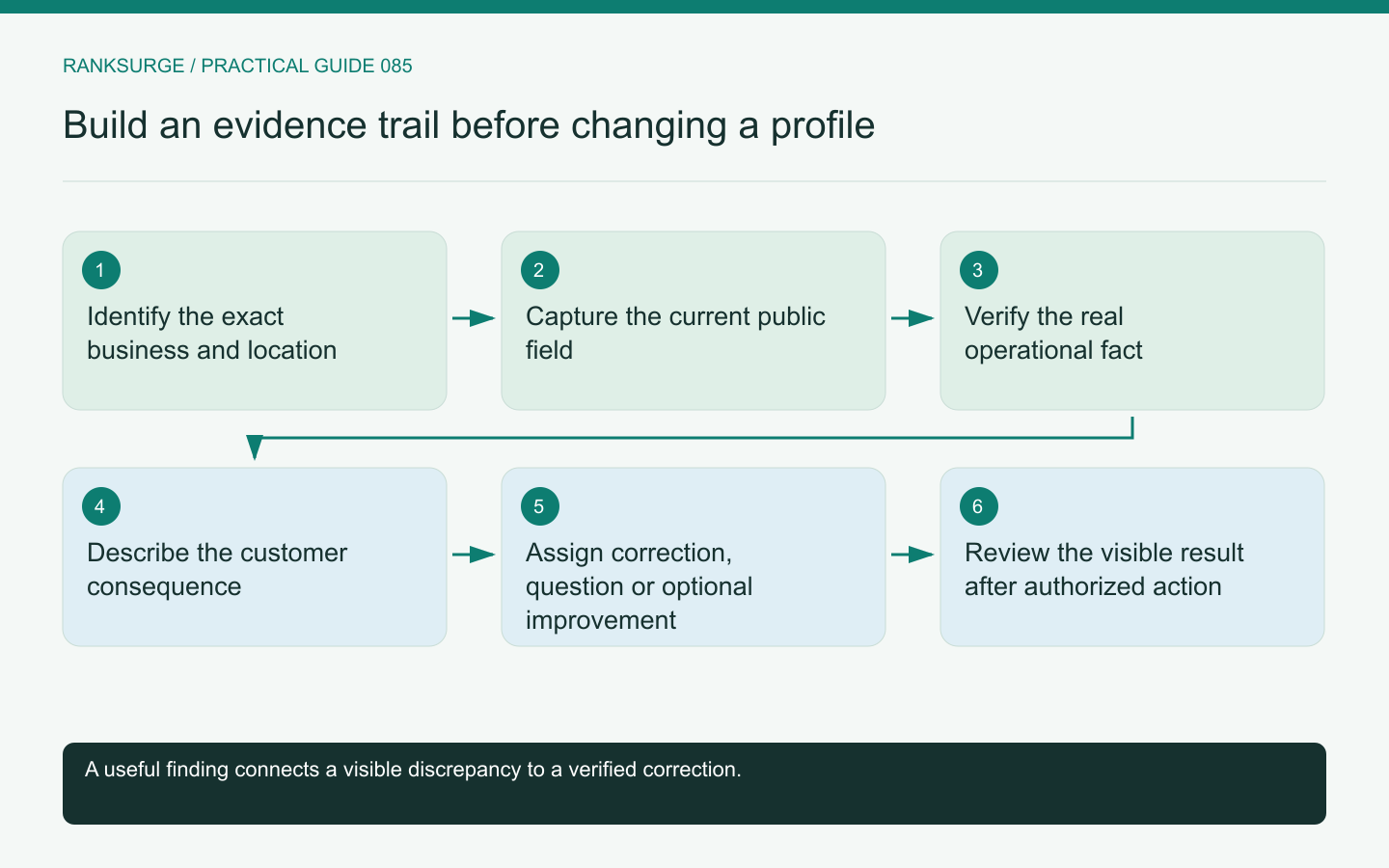
Create a Google Business Profile audit record that separates verified inaccuracies, owner questions and optional improvements before any profile changes are made.
TL;DR
- Make the core audit decision to preserve starting evidence so recommendations are explainable: capture profile identity, observation date and the public information being reviewed before proposing changes.
- Use a clear method: separate operational facts from marketing preferences, note customer consequences for each discrepancy, and prefer screenshots plus text records as reviewable evidence.
- Limit claims by keeping recommendations distinct from edits and by recording unverified scope—only a checked public result confirms a resolution and public‑only audits remain partial.
An audit should preserve the starting evidence
A Google Business Profile audit is more useful when another person can understand why each recommendation was made. A checklist filled with “optimize” does not provide that explanation.
Capture the profile identity, observation date and the public information being reviewed. Keep the business's own confirmed information separate from what appears on the profile.
This creates a comparison between two evidence sets: what the business says is currently accurate and what a customer can actually see. The goal is to identify meaningful discrepancies, not to manufacture a long list of edits.
Verify the business and location being audited
Start with the exact profile and physical or service-area context. Similar names, old locations and multiple branches can lead an auditor to inspect the wrong record.
For a multi-location business, assign each finding to the relevant location. A phone number or opening-hours problem at one branch should not become a recommendation to change every profile.
Record any uncertainty about ownership, duplicates or relocation before continuing. If the profile identity is unresolved, later recommendations about categories and reviews may be attached to the wrong business entirely.
Separate facts from marketing preferences
Some fields describe operational facts: address, contact route, regular hours and the services actually offered. Other suggestions may concern presentation quality, such as clearer photos or a more helpful description.
Label the type of finding. An incorrect opening time can cause an immediate customer problem; a preference for a different description sentence is a different priority.
Google's representation guidelines provide the policy reference for accurate profile information. They should inform the audit without becoming an excuse to add unsupported keywords or claims to factual fields.
Capture the customer consequence
For each discrepancy, explain what a customer could experience. A wrong phone number can route inquiries to the wrong team. Missing special hours can cause a wasted visit. An outdated website link can send a person to an obsolete location page.
This consequence helps prioritize the work without inventing a ranking impact for every field. Not every useful correction needs to be justified as an SEO tactic.
For an illustrative clinic, confirming a holiday closure may be more urgent than replacing an older but accurate exterior photo. The audit should make that operational judgment visible.
Use evidence that can be reviewed safely
A screenshot can preserve what was visible at the time of the audit. Pair it with a text record of the field and the source used to verify the proposed correction.
Avoid collecting unnecessary customer details from reviews or exposing private account information in a shared audit document. Public visibility does not make every personal detail useful to the research.
For owner-supplied facts, record who confirmed the information and when. A staff member's informal recollection of opening hours may need verification before it becomes a proposed public change.
Give each finding a clear status
A practical audit can classify findings as verified correction, owner confirmation needed, optional presentation improvement or no action. These states are more useful than a single pass/fail score.
A verified correction should have a current value, proposed value, evidence and owner. A confirmation item should state the unresolved question. An optional improvement should describe the customer benefit without pretending it is a factual error.
Keep already-correct fields visible where they establish completeness, but do not bury important changes beneath dozens of trivial green checks. The final review should be easy for the business owner to act on.
Keep recommendations separate from edits
An audit does not automatically authorize every profile change. Use the business's approved process to confirm factual edits and identify who can make them.
After an authorized change, record what was submitted and check the visible result. Do not mark the issue resolved solely because someone clicked a save button; the final public state is the outcome the customer encounters.
If a proposed edit is not accepted or the visible information differs, preserve that result and investigate rather than repeatedly submitting speculative variations.
Record what the audit did not verify
State whether the review covered only public information or included authorized account access and owner confirmation. A public-only audit cannot establish every account permission or administrative setting. Mark those areas as outside the verified scope instead of turning an absence of evidence into a failed check. This boundary is especially useful when a second reviewer later receives access and needs to continue the audit without assuming that earlier unanswered questions were already resolved.
Review the audit as a customer journey
Follow the profile from discovery to website visit, contact and arrival or service request. Check whether the important information stays consistent across those steps.
RankSurge can support the surrounding search and competitor research, while profile evidence and edits remain a separate accountable workflow. A strong audit leaves the owner with a short, supported set of actions: what is wrong, why it matters, what should change and how the correction will be verified.
Related reading: SEO for Startups: A Founder’s Handbook.
Related reading: How to Prompt Claude Code for SEO.