
GA4 Organic Search Attribution: Explain What the Report Can Attribute
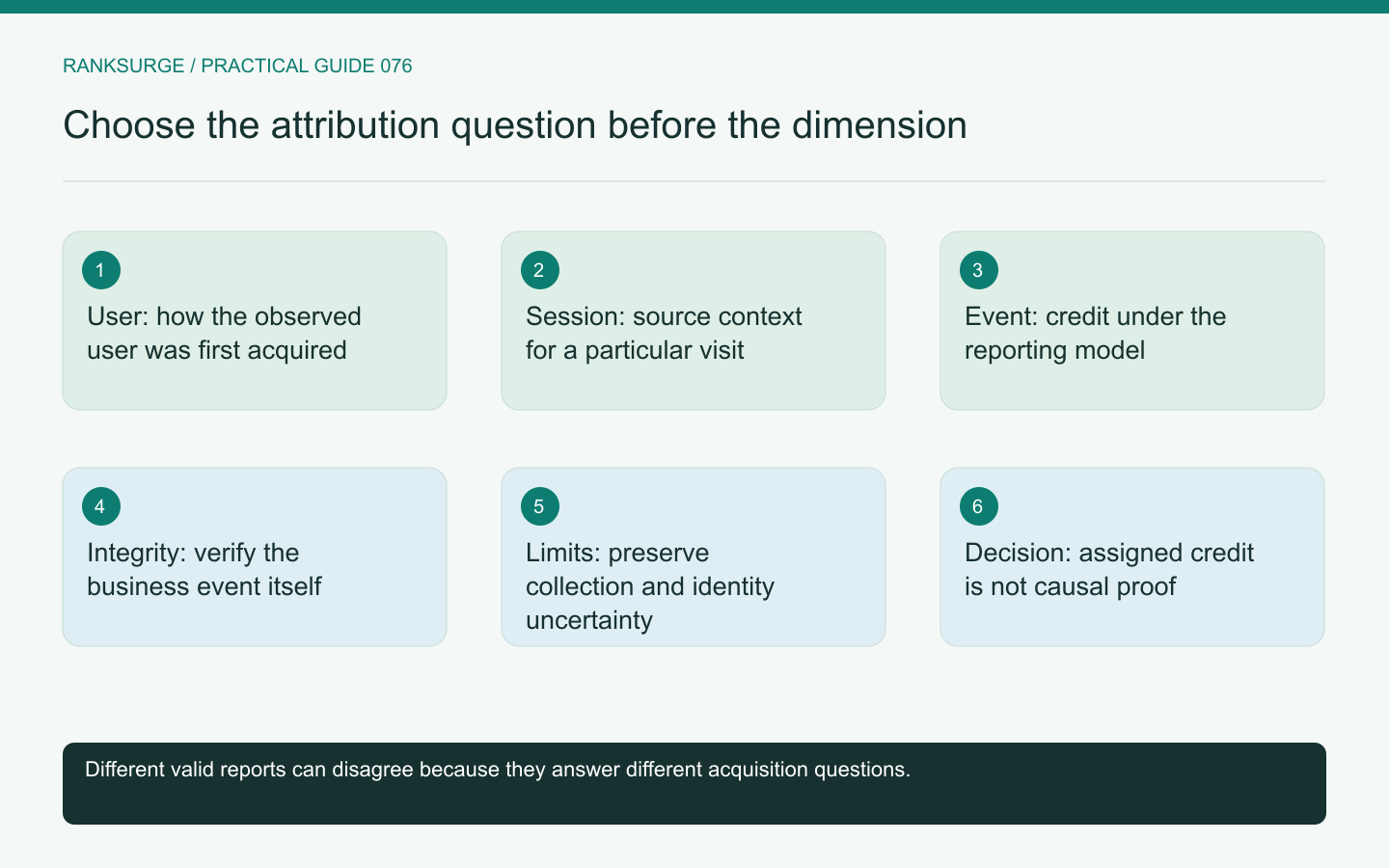
Explain GA4 organic-search attribution by choosing the right user, session or event scope and separating assigned credit from proof of causal impact.
TL;DR
- Define which organic-search question the report answers—user acquisition, session source, or event attribution—and keep that plain-language scope consistent to avoid incompatible numbers and debates.
- When attributing key events, record the report's attribution model and settings, include a sample row with the full dimension name and plain‑language interpretation, and confirm recipients understand the scope.
- Acknowledge data limits and check event quality: keep collection limits visible, use qualified phrasing about credited channels, and compare the same scope and settings consistently over time.
Start with the question the report must answer
“Organic search conversions” can refer to several different questions: which users were first acquired through search, which sessions arrived through search or how credit for a later key event is assigned. Those questions are related, but they are not interchangeable.
Write the intended question before selecting a dimension. Otherwise two analysts can produce different valid reports and spend time arguing about which number is correct when they are measuring different relationships.
The useful report explains its scope in ordinary language and keeps that definition consistent across the comparison.
Distinguish the three traffic-source scopes
Google's traffic-source scope documentation distinguishes user, session and event scopes. Prefixes such as First user and Session help identify the relationship being described.
Use the appropriate scope for the decision. A first-acquisition question is different from a question about the source of a particular visit. Attribution of key-event credit introduces another layer of interpretation.
Do not shorten all three to “source” in an export. Retaining the full dimension name helps prevent a technically valid table from being interpreted as a different kind of evidence.
Work through a returning-customer example
Imagine a person first discovers a product through an organic-search article, returns later through an email and eventually completes a purchase. The story contains several interactions, each relevant to a different business question.
A report about initial acquisition can preserve the role of the first discovery. A session-oriented view can describe a later visit's source. A key-event attribution report can assign credit according to its configured model and available data.
This example is conceptual, not a promise of the exact values every GA4 configuration will produce. Identity, collection and reporting settings affect the observed record.
Record the attribution settings with the report
If the analysis concerns key-event credit, document the reporting attribution model and other relevant configuration. Google's attribution-model guidance explains that changing that model does not change user- and session-scoped traffic dimensions in the same way.
This distinction matters when comparing two dashboards after a configuration update. A difference may reflect a reporting choice rather than a sudden change in customer behavior.
Include a sample row with the full dimension name and a plain-language interpretation. Ask the report recipient to explain it back before standardizing the dashboard; this catches scope confusion earlier than debating a surprising monthly total.
Keep the settings and report date in the handoff. A screenshot showing only the final channel totals cannot explain how those totals were assigned.
Verify the key event before interpreting credit
Attribution is only useful if the underlying event represents the intended business outcome. Confirm whether the event means completed signup, qualified inquiry, purchase or something less conclusive such as clicking a button.
For the returning-customer example, duplicate purchase events would distort the analysis regardless of how carefully the source dimension was selected. A missing event on one payment path could make a channel look weaker than it is.
Test the event against the application's authoritative record, including failure and retry cases. Separate event-quality problems from questions about which marketing interaction receives credit.
Keep collection limits visible
Analytics can observe only the data available under the site's implementation and applicable collection conditions. Cross-device behavior, consent choices and unconnected journeys can limit what the report represents.
Do not fill those gaps with invented certainty. A model can help assign credit within its available evidence, but it does not reveal every unobserved interaction or prove what would have happened without the article.
Use qualified language such as “credited to organic search in this report” when that is what the data actually supports. This is clearer than turning the assigned value into a universal statement that search caused the outcome.
Compare the same scope over time
For recurring reporting, keep the dimension, metric, period policy and attribution settings consistent or annotate intentional changes. Compare the underlying counts as well as percentages.
If an executive report switches from first-user acquisition to session acquisition, explain the change and avoid presenting the new series as a seamless continuation. Both views can be useful, but they answer different questions.
Likewise, do not expect Search Console clicks to reconcile perfectly with GA4 sessions or key-event credit. The systems describe different measurement boundaries and should be connected through an explanation, not forced into identical totals.
Related reading: The Dark Query Problem: Why Search Console Hides Most of Your Searches.
Use attribution to guide a decision, not settle every debate
A useful conclusion identifies the scope, observed pattern and next action. It might recommend improving an organic landing page's next step, verifying a missing event or studying a longer evaluation path.
If the team needs causal evidence about a content investment, plan an appropriate experiment or stronger analytical design rather than relying solely on attribution credit. RankSurge can support SEO evidence gathering, while the analytics interpretation must preserve the difference between observed acquisition, modeled credit and demonstrated impact.
Related reading: SEO for Startups: A Founder’s Handbook.