
Duplicate Titles in a Site Audit: Fix the Page Pattern, Not Every Row by Hand
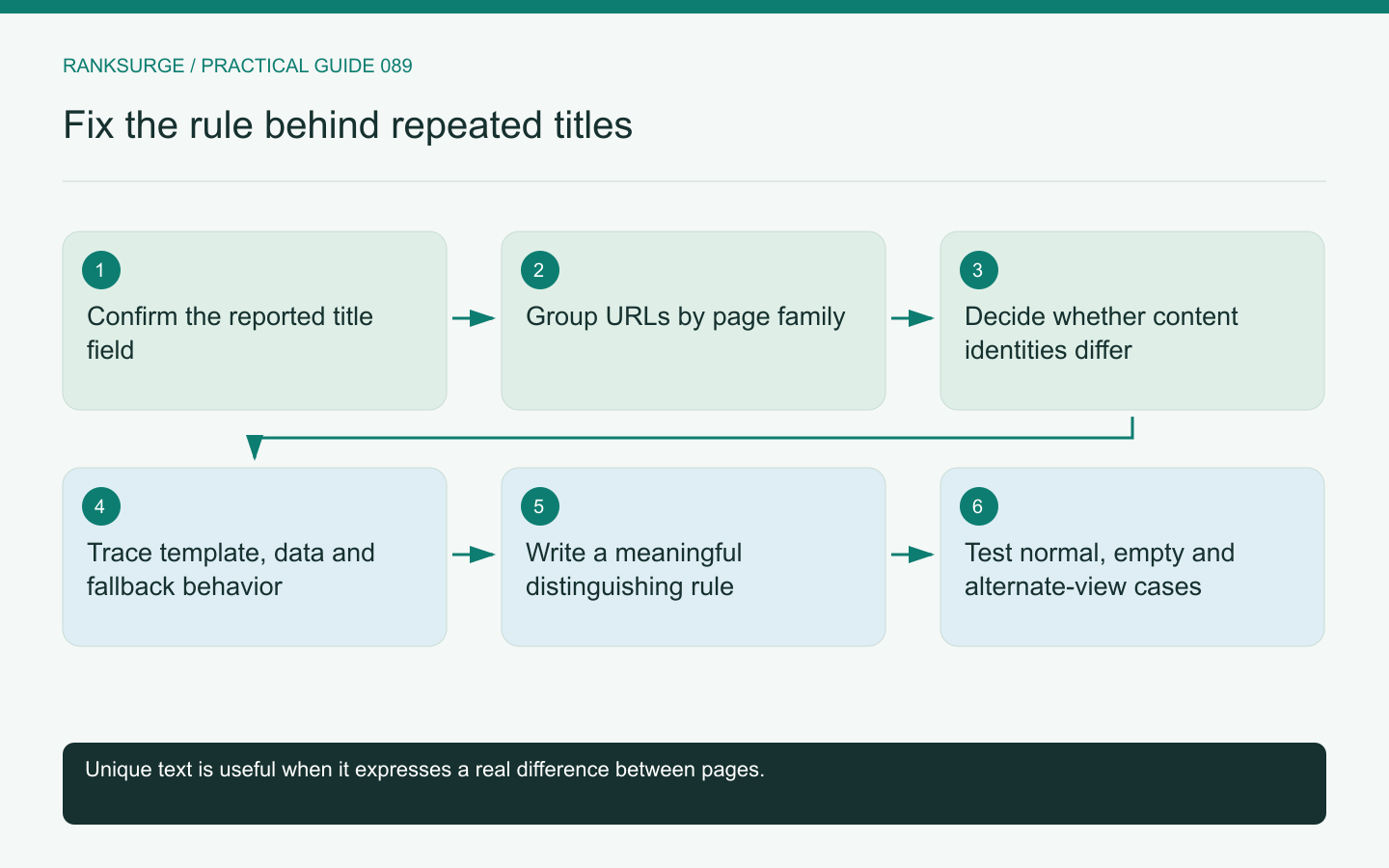
Investigate duplicate page titles by template and content identity, then fix the underlying title rule instead of manually editing every audit row.
TL;DR
- Don’t fix every row manually; treat duplicate-title findings as a pattern and correct the source rule or data handling so titles reflect real page identity instead of superficial uniqueness.
- Investigate by grouping affected URLs into page families, inspect representative examples and trace the title generation back to its source so the developer can fix the rule with proper context.
- Validate success by regenerating or inspecting titles across the whole family, record expected patterns and exceptions, and close the finding with documented cause, corrected rule, and tested examples.
Duplicate titles are a pattern to investigate
A duplicate-title report tells you that several observed pages share the same title text. It does not yet tell you whether the pages should be distinct, whether the title-generation rule is broken or whether the URLs are alternate versions of the same content.
Begin by grouping the affected URLs by page family and inspecting representative examples. The right correction depends on what those pages are intended to represent.
Changing every title by adding a different number can clear a superficial duplicate check while leaving the site's information architecture just as confusing as before.
Confirm the field and rendering context
Check whether the report refers to the HTML title element, a visible heading or a search-result title. These are related but not identical observations.
Google's title-link documentation explains that search-result titles can draw from multiple sources. Editing the page title is therefore not a guarantee of an identical displayed search title.
For a JavaScript application, inspect the relevant rendered and initial output when the crawler's behavior makes that distinction important. A report based on an incomplete render may reflect a fallback title rather than the final page state.
Determine whether the pages deserve distinct identities
Compare the primary content and intended reader task. Two genuinely different service pages need titles that help users distinguish them. Tracking-parameter versions of one page may require a URL and canonicalization review instead.
For an illustrative catalog, products named “Starter Kit” may belong to different product lines. The useful title rule could include the product-line identity, not an arbitrary suffix copied from the database identifier.
If the pages themselves are near-duplicates without a clear purpose, title rewriting alone will not resolve that broader content decision. Document the issue for the appropriate owner.
Trace the title rule back to its source
Find whether the title comes from a CMS field, route metadata function, template default or generated product data. Inspect what happens when the source field is empty.
A common pattern is a fallback such as “Products | Brand” appearing on every page where a product name failed to load. The correction belongs in data handling or template logic, not in a spreadsheet of manual title overrides.
Keep one normal example, one failing example and one edge case in the investigation. This gives the developer enough context to fix the rule without assuming all affected records have the same cause.
Design a title that explains the difference
Use the information that makes the page meaningfully distinct: product name, service scope, location where genuinely relevant or the specific subject of an article.
Avoid stuffing every available keyword into a long repeated title. The reader needs a concise description of the page, not a list of search phrases.
For a documentation site, “Authentication” may be insufficient when several versions or products have separate pages. A title that includes the relevant product or version can clarify the destination, provided that distinction is also real in the content.
Handle pagination and alternate views deliberately
Some repeated titles arise from paginated collections or alternate sorting views. Decide how those URLs are intended to be discovered and indexed before applying a generic uniqueness rule.
A page-number label can help users distinguish collection pages, but it is not a substitute for reviewing the collection's linking and canonical behavior. Similarly, adding the sort order to a title does not prove that every sort variant deserves a separate search presence.
Keep these cases in their own group so a product-detail title fix does not accidentally rewrite collection metadata under the wrong assumptions.
Test the rule across the whole family
After implementation, regenerate or inspect titles for the affected set and a representative set of unaffected pages. Check empty values, special characters, unusually long names and localized content.
Verify that the title remains accurate when a record changes. A manually stored title may become stale if the product name is updated elsewhere without a corresponding edit.
Record the expected title pattern and its exceptions in the acceptance criteria. This makes future audit findings easier to interpret and reduces the chance of reintroducing the same fallback bug.
Avoid mixing unrelated releases into the validation
If possible, keep the title-rule change identifiable in the deployment record. A simultaneous route migration or broad content rewrite makes later interpretation harder. This does not require delaying necessary work, but it does require noting which changes shipped together so a reviewer does not attribute every subsequent search observation to the title correction alone.
Close the finding with evidence
A useful resolution includes the cause, corrected rule, tested examples and any remaining pages awaiting a content decision. Do not mark unresolved alternate-URL questions as fixed merely because the title strings are now unique.
RankSurge's audit observations can identify the pattern, while the implementation should repair the system that produced it. The goal is clear page identity for readers and maintainers, not uniqueness for its own sake.
Related reading: SEO for Startups: A Founder’s Handbook.
Related reading: The Best Open Source SEO Tools in 2026 - RankSurge Blog.