
Daily vs Weekly Rank Tracking: Buy the Frequency That Changes a Decision
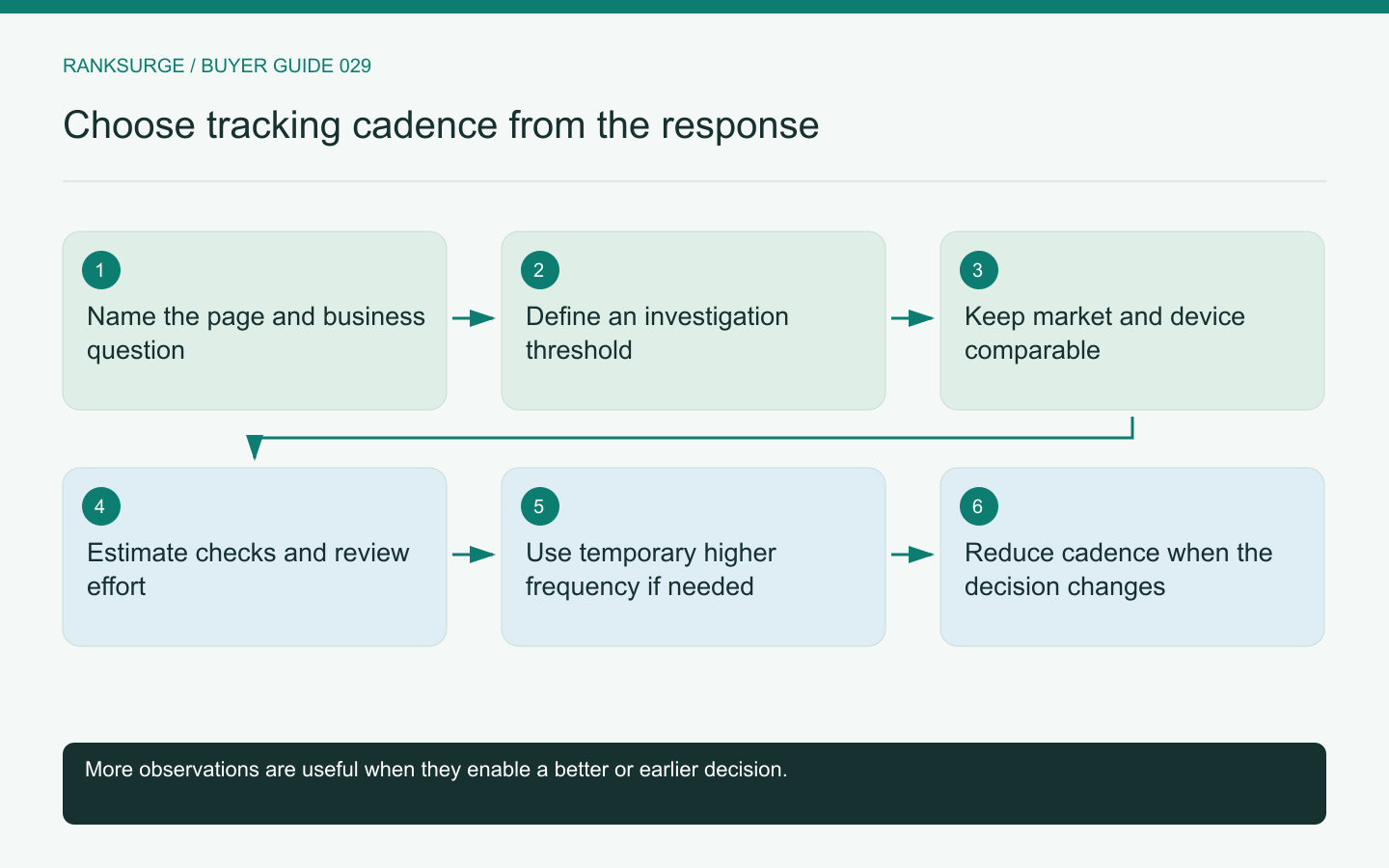
Choose daily or weekly rank tracking based on the decisions you can make, the importance of the pages and the cost of repeated observations.
TL;DR
- Buy rank-tracking frequency only if it would change the team’s response: choose cadence around the specific question, pages, triggers and who would act, and adapt during launches or incidents.
- Separate stable monitoring from active investigation: run slower routine checks for mature sections and temporarily increase observation for migrations or incidents until the team understands which URLs and queries matter.
- Set clear action thresholds and account for effort and gaps before buying more checks: define what will trigger investigation, count all configuration combinations, and verify how missed checks are reported.
Frequency is useful only when it changes the response
Daily rank tracking can reveal changes sooner than weekly tracking, but more observations do not automatically produce better decisions. A team that reviews results once a month may pay for daily checks without using the additional detail. Another team overseeing a migration may need a temporarily closer view.
Choose frequency around the question and response process. Identify which pages matter, what change would trigger an investigation and who would act. The right cadence can differ across keyword groups and can change during a launch or incident.
Avoid treating the fastest available schedule as a default definition of serious SEO.
Separate stable monitoring from active investigation
Stable monitoring asks whether important visibility is changing over time. Active investigation asks what happened around a specific change or event. The second task may justify more frequent observations for a limited period.
Imagine a team tracking a mature documentation section and a newly migrated product directory. The documentation group may support a slower review cycle. The migration group may require closer checks until the team understands which URLs appear and whether important queries remain covered.
These are illustrative operating choices, not universal cadence recommendations. The appropriate interval depends on the business importance, expected volatility and ability to respond.
Define an action threshold before buying more checks
Write what the team will investigate. A single position change may not justify action, while a persistent loss across important queries might. Include page importance, duration and corroborating evidence in the threshold rather than relying on one number.
Ask what a daily observation would let you do that a weekly observation would not. If the answer is only that the chart would contain more points, the additional cost may not be justified. If it enables a timely migration check or detects a configuration issue sooner, the value is clearer.
Keep the response proportional. A tracker should not train the team to rewrite a page whenever the result moves.
Preserve comparable configurations
Frequency does not solve a poorly defined observation. Keep the keyword, location, device and tracked domain or page context explicit. A changed setting can create apparent movement that has nothing to do with the site's actual performance.
RankSurge's rank-tracking documentation describes configured locations and device views. When evaluating cadence in any tool, first confirm that repeated checks preserve the intended configuration.
If you change the setup, annotate the series and avoid presenting it as uninterrupted like-for-like history. A weekly check in a new market is not simply the next point in the old daily series.
Related reading: How to Prompt Claude Code for SEO.
Related reading: How to Use Vellum and OpenSEO for Your SEO Engine.
Calculate the workload with all dimensions
Count the combinations you intend to observe, not just keyword text. Multiple markets or devices can increase the number of checks. Ask the provider how the actual plan meters the configuration and whether limits or credits are shared with other research.
Build a simple worksheet with keyword group, market count, device settings, planned frequency and observed cost. Keep temporary high-frequency investigations separate from permanent monitoring so they do not silently become recurring commitments.
Use current plan terms and trial usage where available. Do not assume competing products charge equivalent units or that a stated keyword allowance includes every configuration you want.
Evaluate gaps and delayed checks
Ask what happens when a scheduled check fails or the account lacks capacity. Does the product show a gap, retry later or carry forward an earlier value? These behaviors affect how useful a higher frequency really is.
A daily chart with hidden missing observations can be harder to interpret than a clearly labeled weekly series. During the trial, inspect a supported failure example or historical gap and verify that the reporting makes the limitation visible.
The team should distinguish “not found within the measured scope” from “the check did not complete.” Those outcomes lead to different investigations.
Plan review effort as well as collection
Someone must interpret the data. Decide which groups receive routine review, which changes produce an alert and where the investigation notes are saved. More frequent collection can create alert fatigue if the response process is not selective.
Use a sample month to estimate review time. Ask whether the team can summarize meaningful changes without spending the entire meeting discussing small fluctuations. If not, improve grouping and thresholds before increasing collection frequency.
Keep ranking evidence connected to first-party performance and the business task, while respecting that these sources measure different things. A position change alone does not establish a change in revenue or user satisfaction.
Revisit cadence when the work changes
After a launch or migration stabilizes, reduce temporary monitoring if the extra checks no longer change decisions. Conversely, increase observation deliberately when a new investigation warrants it. Record why the change was made.
Choose a plan that supports this operating pattern at an acceptable cost. The best cadence is the one that supplies timely, interpretable evidence to a team prepared to act on it. Daily and weekly tracking are tools for different situations, not competing badges of SEO maturity.