
Country and Device Search Differences: Decide Whether the Page Needs a Different Experience
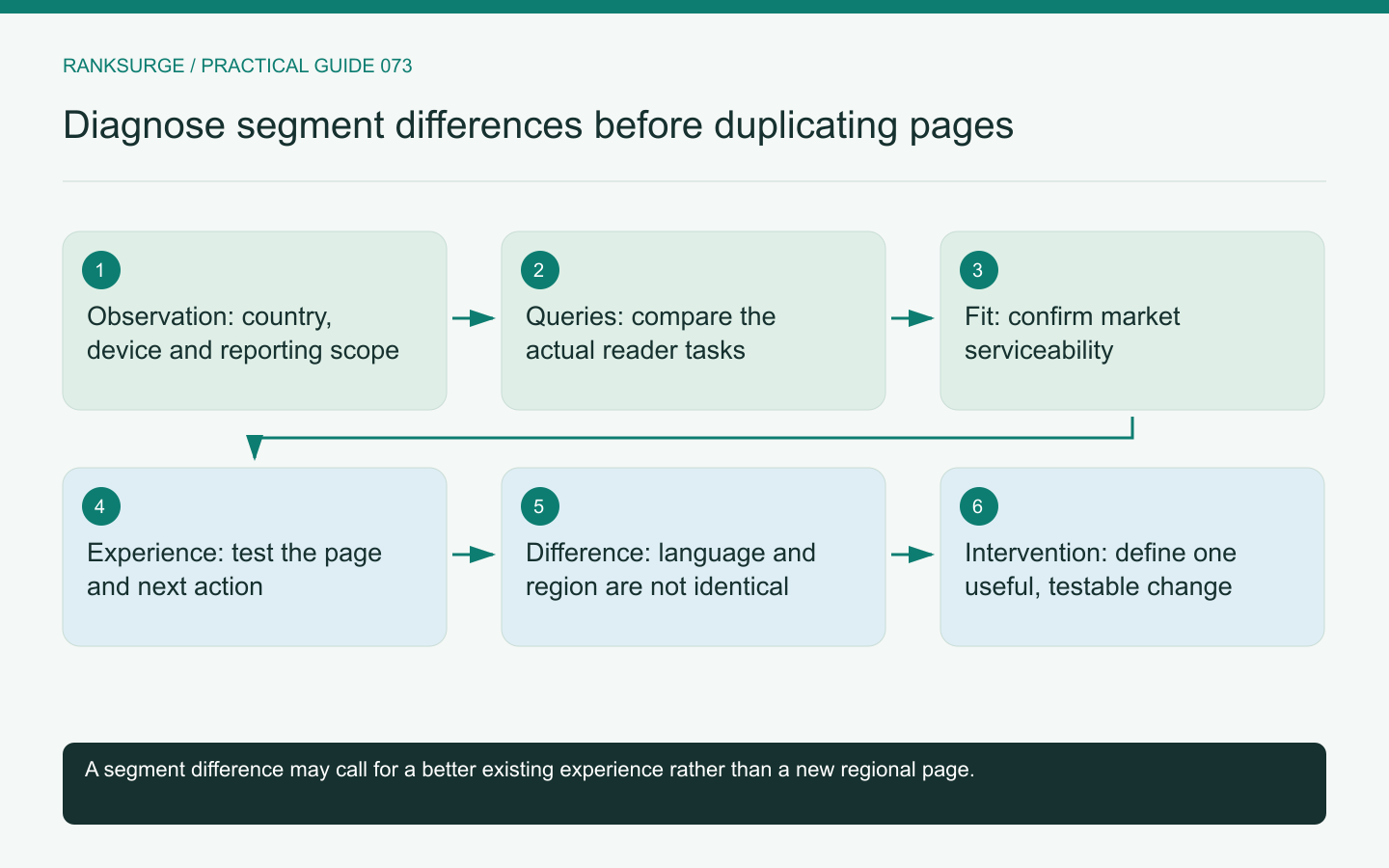
Investigate country and device search differences through comparable queries, service availability and real page behavior before creating separate regional content.
TL;DR
- Treat observed country or device differences as a diagnostic clue: inspect the context and reader task before creating new regional variants, rather than immediately publishing a separate country-specific page.
- Compare the visible query mix and audience tasks before changing design: group representative queries by task, use Search Console country/device dimensions, and preserve filters and period for reproducible comparisons.
- Choose focused interventions and define success up front: write a hypothesis with an acceptance test, then report the segment, period, observed task and evidence rather than overgeneralizing the difference.
Treat a difference as a diagnostic clue
A page can perform differently across countries or devices for several reasons: different queries, different customer needs, a different result context or a problem in the page experience. The segment alone does not identify the cause.
Start with a specific observation and a plausible question. For example, an appointment-software guide may receive many mobile impressions in one country but relatively few visits. The next step is to inspect the context, not immediately create a country-specific copy of the article.
Keep the investigation tied to a reader task the product can genuinely serve.
Compare the query mix before the page design
Different segments may contain different searches. One market might primarily discover a broad educational query, while another searches a product name or a narrow buying term.
Review a representative set of visible queries and group them by task. If the groups differ substantially, the aggregate performance difference may reflect audience composition rather than a broken mobile layout.
Google's Search Console performance report supports country and device dimensions. Preserve the filters and period so the comparison remains reproducible, and do not treat missing query detail as a complete picture of every searcher.
Related reading: The Dark Query Problem: Why Search Console Hides Most of Your Searches.
Check whether the product serves the market
Before investing in a localized landing page, confirm availability, supported language, billing and relevant operational constraints. Search exposure in a country is not proof that the product can meet the needs of customers there.
For the appointment example, a local payment method or support-language requirement may materially change the buying decision. If the product cannot support it, a page should not imply otherwise merely to capture demand.
The research can still identify a future expansion question. Keep that separate from a current content claim or a promise in the call to action.
Inspect the actual mobile task
Open the page at a realistic narrow width and follow its main action. Check whether a comparison table is readable, an important limitation is visible and the destination works without hidden controls or obstructive overlays.
For the guide example, a wide selection matrix may become impossible to compare on a phone. The useful fix could be a clearer stacked presentation or a concise summary, not another article targeting the same query.
Ask a reviewer to complete the page’s primary task without guidance and record the point of confusion. A task observation is more specific than saying the mobile page “feels worse,” and it gives the implementation team a reproducible condition.
Use actual content fixtures, including long product names and localized text. A clean screenshot with short placeholder labels can miss the condition that real readers encounter.
Distinguish language from country
A country segment can include several languages, and one language can serve readers across many countries. Do not infer the recipient's language preference solely from geography.
Google's multi-regional and multilingual guidance is relevant when a site genuinely needs multiple regional or language versions. The editorial decision still begins with what information must differ for the reader.
If the same accurate guide serves several markets, retain a clear common destination. Separate pages should have a meaningful, maintainable purpose rather than a different country name pasted into the introduction.
Check the destination after the article
The blog page may be readable while the next step fails for a segment. A mobile visitor could encounter a difficult form, or a reader in another market could reach pricing that does not explain availability clearly.
Trace the intended path from search result to page to action. Record where the experience becomes unclear or unsupported. This prevents the SEO team from repeatedly rewriting content when the real issue lies in the product or conversion flow.
Keep observational evidence separate from measured conversion claims. A found usability problem can justify a fix without inventing an exact amount of lost revenue.
Related reading: SEO for Startups: A Founder’s Handbook.
Choose a focused intervention
Possible actions include clarifying market availability, improving a mobile comparison layout, translating a supported workflow or leaving the page unchanged while investigating a different query mix.
Write the hypothesis and the acceptance test. For example: “Readers can compare all three selection criteria on a narrow display without horizontal ambiguity.” That is directly reviewable before waiting for search data.
Avoid changing several unrelated elements simply because a segment looks weak. A focused intervention makes both implementation review and later interpretation more useful.
Report the difference without overgeneralizing
The final note should identify the segment, period, observed task and evidence for the proposed action. State what remains unknown and whether the issue concerns content, product availability or the user journey.
RankSurge can support the research context, while the team owns the decision about what experience a particular audience needs. Country and device analysis is most useful when it produces a specific improvement for real readers, not an automatic multiplication of regional pages.