
Content Gap Tools: Evaluate Product Fit Before Counting Missing Keywords
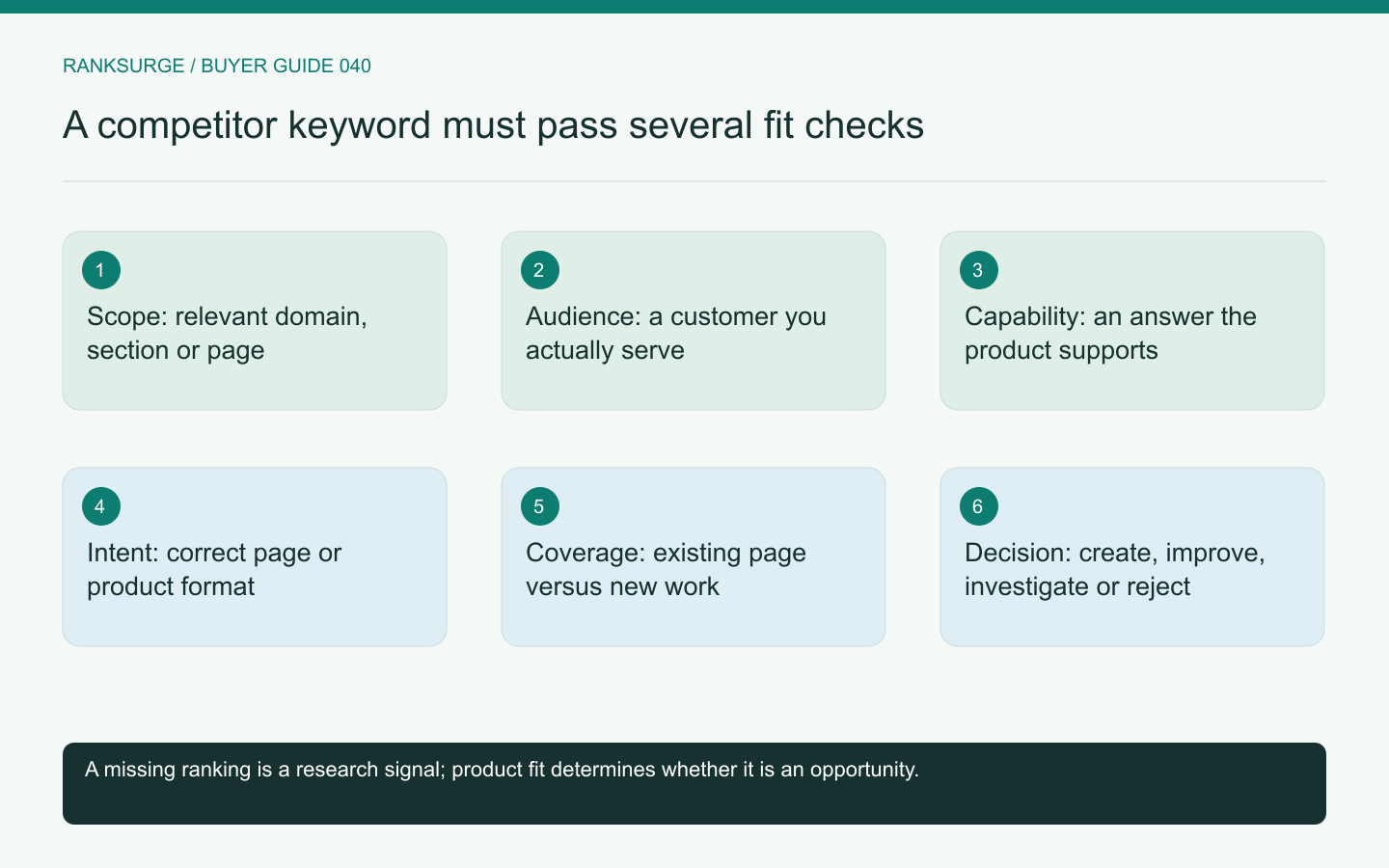
Evaluate content gap tools by filtering competitor keywords through product fit, page intent and existing coverage before creating a publishing backlog.
TL;DR
- Decide an acceptance rule up front: a useful gap must match an audience you serve, a task you can help with, and a page your team can maintain rather than any missing keyword.
- Use focused trials and inspection: compare domain versus section scope, run the same trial with broad and relevant scopes, open representative search results, and retain rejections with reasons.
- Treat tool output as research, not a backlog: require a small reviewed list with four outcomes and preserved evidence; success is when competitor research sharpens your own useful coverage.
Define what counts as a useful gap
A content gap tool usually identifies queries or topics where another site has visibility and yours does not. That difference can reveal an opportunity, but it can also reflect a different business, an unsupported product capability or content you deliberately chose not to publish.
Before comparing tools, define your acceptance rule. A useful gap should match an audience you serve, a task you can help with and a page your team can maintain. The absence of a ranking is a research signal, not a publishing instruction.
Use a small competitor set with known roles. Include a direct product competitor and, if relevant, a publisher that competes for search attention. Keep those roles visible so the tool's largest keyword list does not quietly redefine your business strategy.
Compare the scope of competitor data
Ahrefs describes Content Gap as a way to identify keywords through competitor comparisons. When evaluating any such tool, ask whether the comparison uses entire domains, subfolders or individual pages, and how the chosen scope changes the result.
A competitor's support portal can rank for product-specific errors that are irrelevant to your customers. Its careers section can contribute unrelated demand. A domain-wide comparison may be useful for discovery, but it needs filtering before it becomes a content plan.
Run the same trial with a broad competitor domain and a relevant product section where supported. Inspect the difference. The purpose is to understand the data boundary, not to choose whichever setting produces the most opportunities.
Review a deliberately unsuitable result
Choose one returned keyword with attractive metrics but poor product fit. For an illustrative hosted software company, that might be a query asking for an offline installation package the company does not offer.
Ask the tool's workflow to retain a rejection reason. The term may belong in a transparent alternatives discussion, but it should not become an installation guide that misrepresents the product. A good research process can say no without losing the evidence behind the decision.
Also inspect competitor-branded navigation queries. Someone searching for a specific vendor's login page is not necessarily evaluating alternatives. Treating that query as a generic acquisition opportunity can produce a page that fails the reader's actual task.
Inspect the page type behind a promising term
Open representative search results for the shortlisted query. Determine whether the visible pages are comparisons, category pages, documentation, calculators or editorial explanations. The content gap may be a missing product experience rather than a missing blog post.
For example, a query that consistently leads to interactive tools may deserve a product investigation. A query about evaluating vendors may deserve a carefully sourced buying guide. Do not let the availability of a blog editor determine the answer before the research is reviewed.
RankSurge's keyword research workflow can help inspect queries and search results. The buyer should test whether the evidence can be saved with a page decision, including cases where the decision is not to write an article.
Related reading: SEO for Startups: A Founder’s Handbook.
Related reading: How to Use Vellum and OpenSEO for Your SEO Engine.
Check your own coverage semantically
Search your current inventory for pages that answer the same reader need using different wording. A keyword-level gap can coexist with substantial topical coverage. The right action may be to improve an existing page's clarity or add a missing section.
Use a trial case where your site already has a comprehensive guide but the competitor ranks for a related phrasing. Ask the platform to support a page-level review rather than immediately add a new title to the backlog.
Record the existing canonical destination and the intended improvement. This prevents several analysts from independently commissioning near-duplicate pages from different keyword exports.
Prioritize with uncertainty intact
Compare product fit, commercial relevance, current search evidence and the effort needed to create a useful page. Volume and difficulty can inform the discussion, but they should not override an obvious mismatch or become a guarantee of results.
Keep unavailable metrics unknown. If a narrow but valuable customer question lacks reliable volume data, your team can still make a qualitative decision. Label the evidence honestly rather than inventing a precise score to force every idea into the same ranking formula.
Google's helpful-content guidance is a useful final check: the proposed page should add value for its intended audience. Rewriting a competitor's answer because the keyword looks attractive is not a sufficient editorial brief.
Buy a filtering workflow, not an endless backlog
At the end of the trial, ask for a small reviewed list with four outcomes: create, improve, investigate and reject. Each entry should preserve its competitor evidence, product-fit reasoning and next owner.
Compare how easily another team member can understand those decisions. A tool that finds fewer raw gaps but preserves good reasoning may save more work than one that produces thousands of unqualified suggestions. The purchase succeeds when competitor research sharpens your own useful coverage, not when it fills a calendar with pages your product cannot support.