
Competitor Ranking Movement: Check the Shared SERP Before Reacting
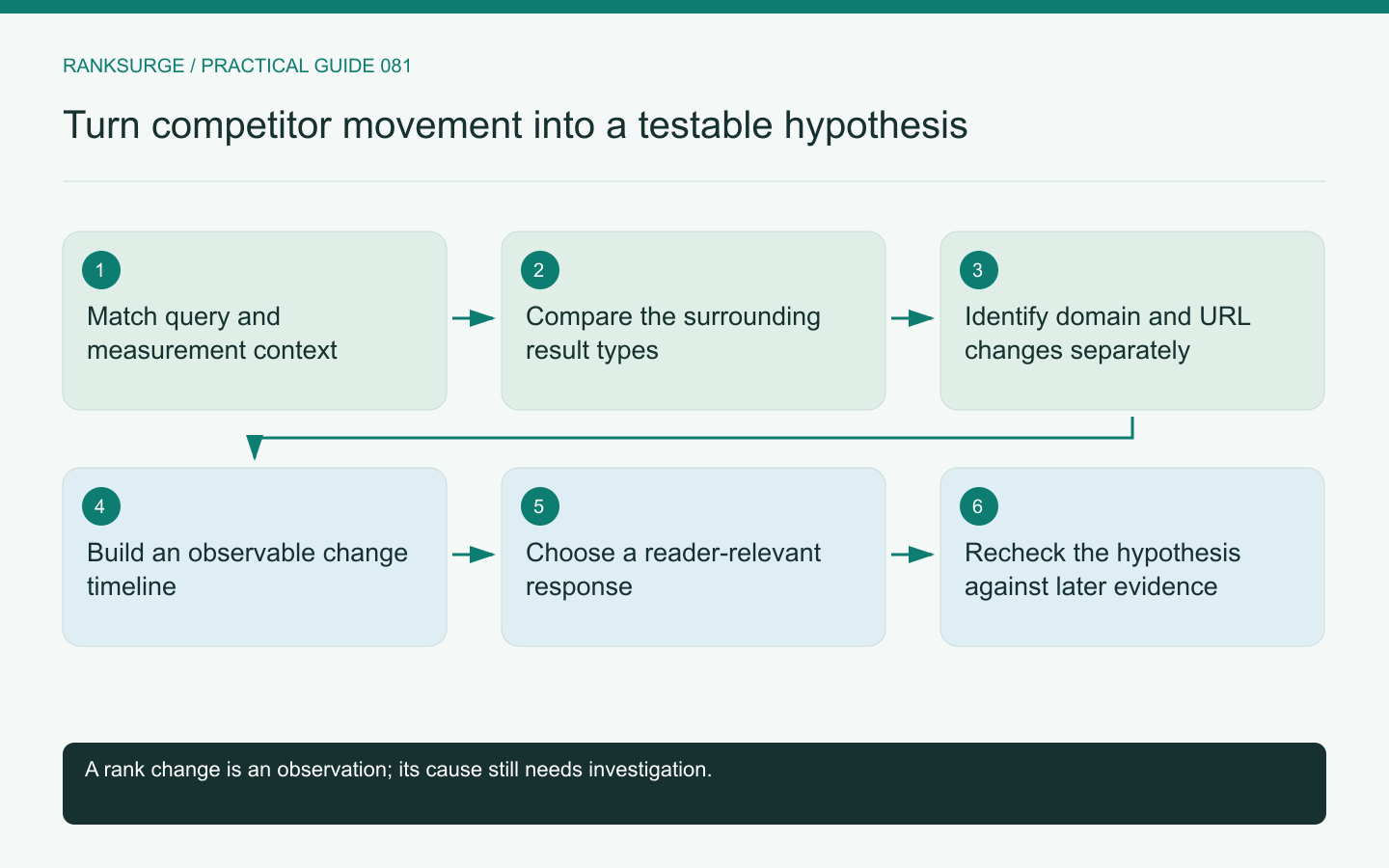
Investigate competitor ranking changes by comparing the same query, location, device and result type before changing your content or SEO priorities.
TL;DR
- Treat a competitor moving above your page as a prompt to inspect the shared SERP, not proof of causation; start from a defensible observation about a URL’s changed position.
- Compare measurement context and surrounding results before acting: match query, location, device and time, and read pages above and below to see whether result types or intent shifted.
- Decide only on responses backed by evidence: document the intended reader improvement, owner and measurement to revisit, and keep a reviewable observation record to check outcomes.
Movement is a comparison, not an explanation
A competitor moving above your page is a reason to inspect the search results. It is not proof that their latest article, backlink or design change caused the movement.
Begin with the observation you can defend: a particular URL appeared in a different position for a defined query under a defined measurement setup. Keep the explanation open until you have inspected the surrounding results and the pages involved.
This distinction prevents a common waste of effort: copying the most visible competitor change while ignoring a shift in search intent, a changed result layout or a problem with your own page.
Match the two observations
Before interpreting movement, compare the query text, location, language, device, search engine and collection time. A desktop result from one country is not a clean baseline for a mobile result from another.
DataForSEO's SERP documentation describes the search-result collection context. Preserve the relevant settings in your research notes even when the interface presents a simple rank number.
For a location-sensitive query, also record whether the measurement used a city-level context or a broader market. A changed location setting can look like a dramatic competitor gain without representing a change for the same audience.
Inspect the whole result set
Read the pages immediately above and below both competitors. The question is not merely whether one rival improved, but whether the result set now favors a different kind of answer.
Suppose a query previously showed product category pages and now includes several comparison guides. Your competitor may have benefited because their page fits that emerging format. Copying their title alone would miss the more useful question: does your page serve the decision implied by the current results?
Record the observed page types and the task each appears to serve. Treat the classification as editorial analysis, not as a hidden ranking-factor measurement.
Separate domain movement from URL replacement
A competitor can retain a similar domain-level position while Google selects a different page from that site. Conversely, one URL can fall while another URL from the same domain rises.
Track the landing URL associated with each observation. A new comparison page replacing an old homepage suggests a different investigation from an unchanged product page moving two places.
For your own site, check whether the intended page still appears. An unexpected internal URL may indicate that your content structure or signals need attention, even if the domain's headline rank looks stable.
Compare changes without claiming causation
Build a short timeline of observable changes: publication dates when reliable, substantial page revisions, redirects, internal-link changes and your own deployments. Include the first measured ranking change and the dates of subsequent checks.
A sequence can support a hypothesis, but temporal order alone does not prove the cause. Several changes may have happened together, and the search engine may have reevaluated many sites at the same time.
Google's traffic-drop investigation guidance offers a broader diagnostic reference. Use it to keep technical and demand-related explanations in view rather than assuming every loss is a competitor content win.
Related reading: How to Use Vellum and OpenSEO for Your SEO Engine.
Decide which response has evidence behind it
Consider an illustrative software query where your page moves from fourth to sixth while a competitor's comparison page moves from seventh to third. Inspection shows that most leading pages now help readers compare implementation options, but your page is a short feature announcement.
A reasonable response is to evaluate whether a more complete decision page is needed. It is not reasonable to promise that adding the competitor's headings will restore the old position.
Document the intended reader improvement, the owner and the measurement you will revisit. The action should remain worthwhile even if the ranking response is slower or smaller than hoped.
Consider the opportunity cost of reacting
Before assigning a rewrite, compare the likely value of the affected query with the team's existing work. A low-fit phrase can consume substantial effort because a recognizable rival happens to rank for it. Keep the original business-fit assessment in the decision record. If the query attracts a task your product does not serve, the right response may be to monitor it while investing in a more relevant page, rather than escalating a competitive reaction into an unnecessary content project.
Keep a reviewable observation record
A useful record contains the query, market settings, both timestamps, observed URLs, result types, the hypothesis and the next check. Add screenshots or exports where your tools permit them, while keeping collection limitations visible.
Repeat the observation before escalating a small one-time change. For a high-value page with a simultaneous technical failure, investigate immediately rather than waiting for an arbitrary persistence rule.
RankSurge can support the research and monitoring process; your analysis should connect the evidence to a specific decision. The goal is a defensible response to a changed search landscape, not a running contest to imitate every visible competitor edit.
Related reading: SEO for Startups: A Founder’s Handbook.