
Competitor Keyword Gaps: Reject Irrelevant Wins Before Building a Roadmap
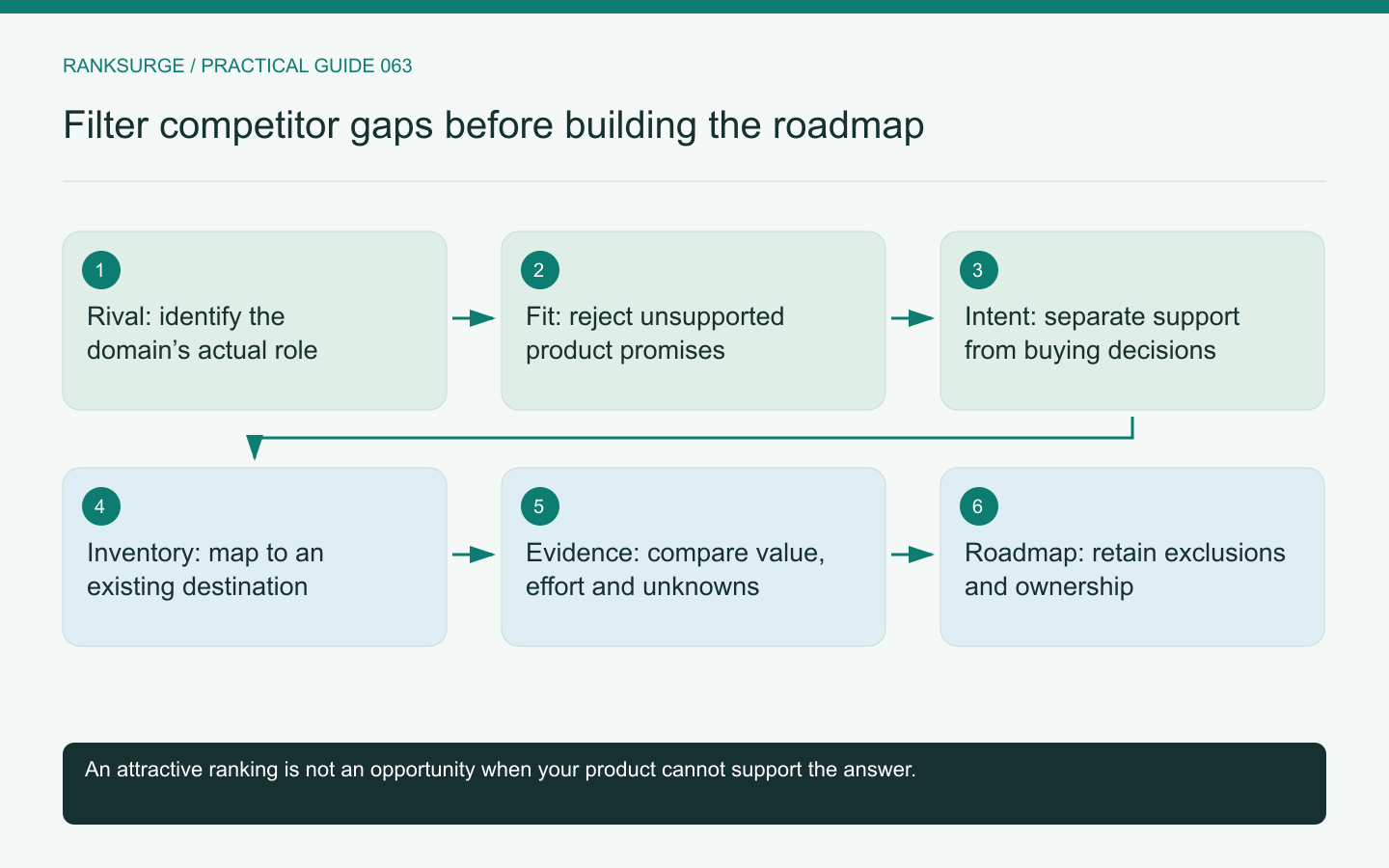
Prioritize competitor keyword gaps by product fit, reader task and existing coverage, with explicit reasons to reject attractive but irrelevant rankings.
TL;DR
- Treat a competitor ranking as a candidate, not an assignment: investigate each gap and deliver a filtered roadmap that explains which tasks to pursue and why.
- Use a methodical check of rival type, product fit and existing coverage: identify who ranked, map retained ideas to current pages, then rank opportunities by a complete case.
- Reject unsupported promises and keep exclusions visible: remove topics your product can't support, record rejection reasons, and include deferred items with concise rationales in the roadmap.
A competitor gap is a candidate, not an assignment
A competitor ranking for a query your site does not cover can reveal an opportunity. It can also reveal a market you do not serve, a support task belonging to that competitor or a page type your business cannot credibly reproduce.
Start by treating the export as a list of questions to investigate. A ranking difference alone does not establish that your site should publish a matching article. The useful deliverable is a filtered roadmap with a clear explanation for each selected task.
Check what kind of rival produced the gap
Identify whether the domain is a direct business competitor, a specialist publisher, a directory or a platform with a different audience. Their rankings may be informative for different reasons.
For an illustrative appointment-software company, a large healthcare directory may rank for medical-service searches. Those queries can be commercially valuable to the directory while being unsuitable for a scheduling product's blog.
Record the rival's role beside the evidence. This prevents a broad domain export from silently becoming a claim that every successful page is relevant to your own customers.
Reject unsupported product promises first
Before comparing volume or difficulty, ask whether your product and expertise can support the answer. Remove topics that require capabilities you do not offer unless the intended article can transparently explain a relevant limitation or alternative decision.
For example, “offline appointment scheduling for remote clinics” should not become a product recommendation if the application requires continuous connectivity and has no supported offline workflow. A large demand estimate does not make the claim truthful.
Keep the rejection reason. If offline support is introduced later, the team can revisit the topic with a precise understanding of what changed.
Distinguish competitor support queries from category needs
A search about resetting a competitor's account, locating its invoices or fixing a specific error often belongs to that product's support experience. It may have little value as a new page on your site.
A broader question about evaluating invoice exports or choosing account-recovery policies could be relevant, but it requires a different brief. Do not rewrite a support query into a buying comparison without evidence that the reader actually wants to switch.
This distinction helps avoid pages that attract frustrated users but fail to answer the question they arrived with.
Map retained ideas to existing destinations
Review your current product pages, documentation and articles. A missing ranking does not necessarily mean missing content. The site may already answer the task but need clearer structure, stronger evidence or a more appropriate destination.
For the scheduling example, a query about timezone handling might map to an existing implementation guide. The next action could be adding a worked cross-timezone example rather than creating another broad article.
Use RankSurge's keyword research workflow to support the evidence collection, while keeping the editorial destination decision explicit in the project record.
Related reading: SEO for Startups: A Founder’s Handbook.
Related reading: How to Use Vellum and OpenSEO for Your SEO Engine.
Rank the remaining opportunities by a complete case
For each candidate, summarize reader importance, product fit, available evidence, current coverage, reported demand and estimated work. Preserve unknown metrics instead of assigning optimistic values.
An illustrative shortlist might contain a relevant comparison with moderate measured demand, a customer-requested workflow explanation with unknown volume and an unsupported high-volume category. The first two can deserve work for different reasons; the third should remain excluded despite its attractive number.
Avoid hiding these distinctions inside an unexplained score. A short written recommendation is often more useful than a weighted formula whose assumptions nobody can defend.
Inspect the actual ranking page before briefing
Read the page that appears to perform well and identify the task it serves. Note the format, evidence, limitations and useful features, but do not copy its outline or assume those visible characteristics caused its ranking.
The purpose is to understand the standard of answer a reader encounters. Your own brief should specify the original contribution you can make: a verified workflow, a clearer decision aid or evidence grounded in your actual product.
Google's helpful-content guidance provides a useful quality check against producing a derivative page simply because a competitor has one.
Deliver a roadmap with exclusions visible
The final roadmap should include selected tasks, assigned destinations, evidence dependencies and owners. Keep deferred and rejected ideas accessible with concise reasons, rather than deleting them and inviting the same debate next month.
For each accepted item, specify the first useful deliverable: a revised comparison section, a new verified workflow example or a complete new guide. This prevents approval of the topic from being mistaken for approval of an unnecessarily large writing project.
Review a small sample of rejected high-volume terms with the team. This demonstrates that the research process is optimizing for useful, supportable coverage rather than maximum keyword count. A competitor gap becomes valuable when it leads to a better reader answer your business can honestly provide.