
Choosing SEO Competitors: Separate Business Rivals From Search Rivals
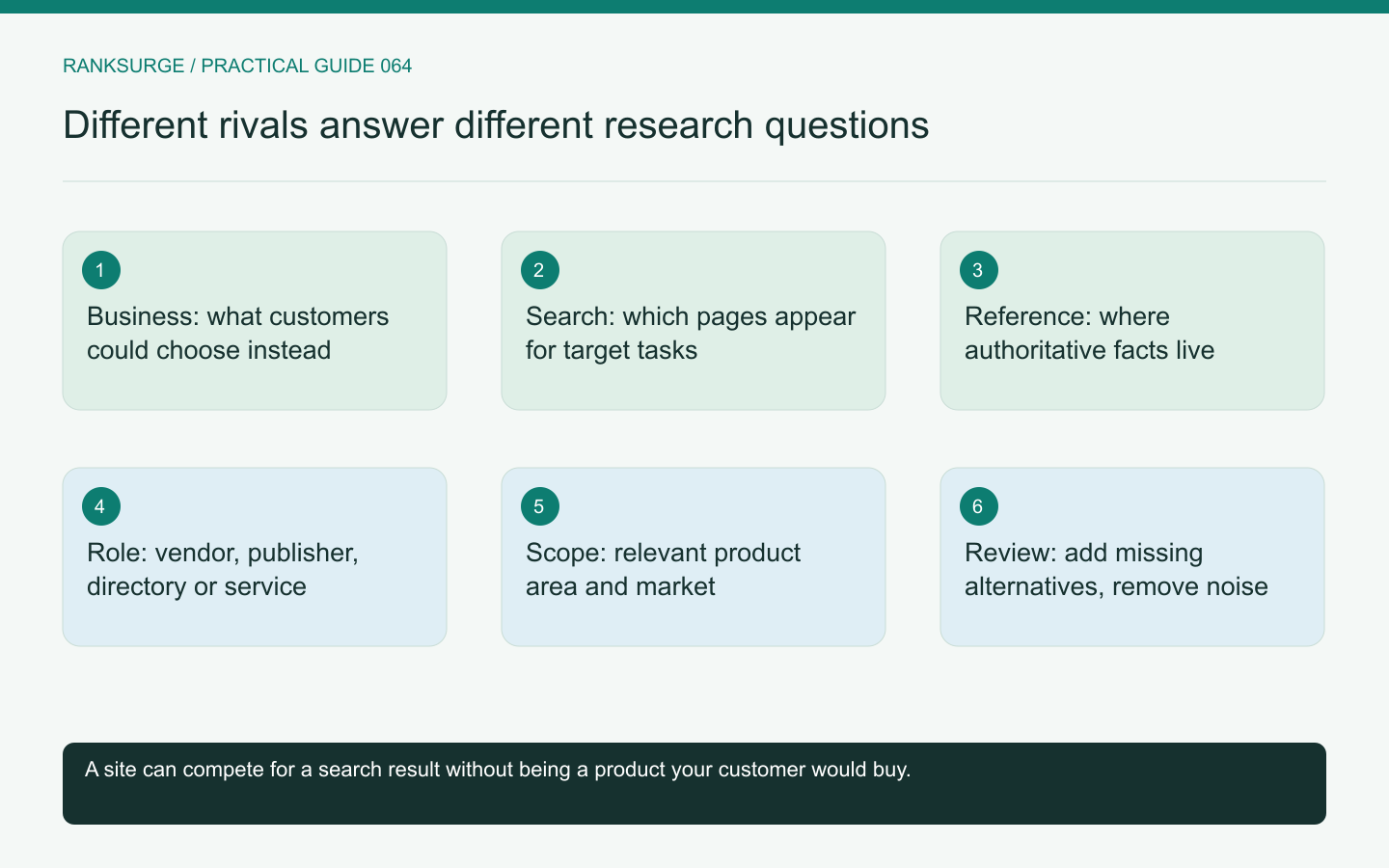
Choose SEO competitors by separating business substitutes, search-result rivals and reference publishers, then use each group for the right research question.
TL;DR
- Decide upfront to treat business competitors and search competitors as distinct lists so research answers the intended question about customer choice versus which sites appear for target queries.
- Build each list from actual customer alternatives and a separate search-result sample: inspect representative queries, record domains and page types, and label roles to guide analysis.
- Keep the competitor list manageable, document why entries belong, and validate by testing for missing rivals or repeatedly irrelevant domains to ensure practical, reviewable research.
Use more than one definition of competitor
A business competitor is a product or service a customer might choose instead of yours. A search competitor is a site appearing for queries you want to understand. The two groups overlap, but they are not identical.
A specialist publication can compete for attention without selling a substitute product. A direct rival can be commercially important even when its search visibility is limited. Naming the distinction at the start keeps the research from answering the wrong question.
Build the competitor list around the decision the research is meant to support, rather than adding the largest familiar domains by default.
Start with actual customer alternatives
Ask what customers compare during a real purchase: another platform, an internal process, a spreadsheet or a service provider. Review appropriate sales and product evidence without exposing private customer details.
For an illustrative inventory-management product, the alternatives might include another SaaS platform and a manually maintained spreadsheet. The spreadsheet has no single competing domain, but it still shapes the product's positioning and the questions a buyer needs answered.
Record why each alternative belongs on the list. “Mentioned in evaluations” is more informative than “well-known company,” and the evidence can be revisited as the market changes.
Build a separate search-result sample
Choose a small set of representative queries that reflect the intended audience and tasks. Inspect the domains and page types appearing in the relevant market, with the date and context recorded.
Do not select competitors from one broad head term alone. A product may encounter different rivals for category comparisons, integration questions and technical documentation. A diversified sample shows those distinctions more clearly.
For the inventory example, a publisher may dominate general educational queries while vendor pages appear for software evaluations. Those observations should produce different research questions, not one undifferentiated ranking league table.
Label each domain's role
Use simple categories such as direct substitute, adjacent product, publisher, directory, marketplace or official reference. A domain can have more than one role, but explain which role matters for the current analysis.
An official standards document can be a valuable reference for understanding a technical query. It may be a poor candidate for a commercial keyword-gap comparison. A directory can reveal selection criteria while also ranking for many locations or categories your business does not serve.
The role label helps analysts filter exports and prevents irrelevant pages from acquiring priority merely because they belong to a strong domain.
Compare at the level of the decision
For business competitors, study supported capabilities, workflows, pricing structure where verified and the tradeoffs a customer must resolve. Use current primary documentation for factual claims.
For search rivals, study the reader task, page format and information available in the result. Do not assume that a publisher's traffic model or a marketplace's page architecture is appropriate for your product site.
For the spreadsheet alternative, the useful comparison may concern maintenance effort, collaboration and error handling rather than a vendor feature matrix. The research method should fit the alternative, not force every entry into the same template.
Keep the list manageable and reviewable
A smaller list with documented reasons is often more useful than dozens of domains that nobody can explain. Start with enough variety to represent the important customer decisions and search contexts.
Record the selected domain, role, relevant queries or decisions, source date and exclusions. If a broad domain is included only for one product section, note that scope so later research does not pull in unrelated business units.
RankSurge's research features can support competitor investigation. The project record should still preserve the human-readable rationale for why each competitor matters to the selected customer decision.
Related reading: SEO for Startups: A Founder’s Handbook.
Related reading: How to Prompt Claude Code for SEO.
Test the list against a missing rival
Ask what important alternative the current list would fail to reveal. This counterexample may expose a service provider, an open-source option or a do-it-yourself workflow that a search-only approach missed.
Also ask which listed domain contributes little useful evidence. Remove or narrow entries that repeatedly produce irrelevant topics. A competitor list should evolve with the product and customer decision process rather than become a permanent collection of logos.
Do not interpret removal as a claim that the company is unimportant. It may simply be outside the scope of the current research project.
Assign each research task to the right group
Use the business-alternative list for positioning and buyer questions. Use the search-rival list for result expectations and topic discovery. Use official references to verify facts and definitions.
When a domain belongs to several groups, keep those uses distinct in the notes. This produces a more defensible roadmap: the team knows which alternatives customers consider, which pages searchers encounter and which sources substantiate the eventual answer. That clarity is more valuable than a competitor list assembled only from the biggest names in the category.