
Canonical Conflicts: Check Links, Redirects and Sitemap Signals Together
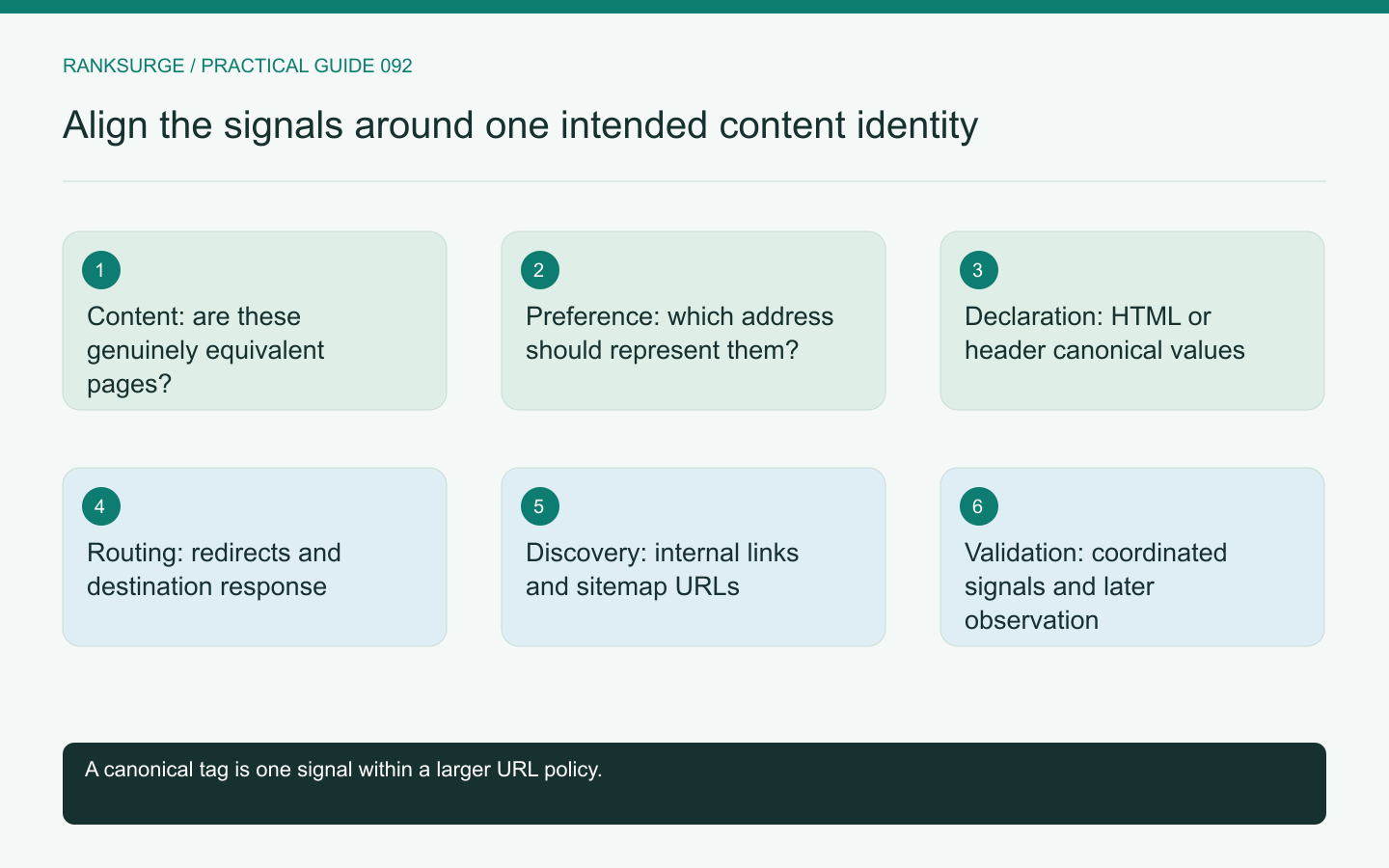
Investigate canonical conflicts by comparing page content, declared canonicals, redirects, internal links and sitemap references before changing one signal in isolation.
TL;DR
- Decide and document the single intended canonical URL for a content set before changing tags, so teams share the same preferred host, protocol, path and parameter treatment.
- Audit declared canonicals, redirects, internal links and sitemap entries together, then create a coordinated mapping of current signals to desired signals and name the systems that generate each.
- Treat success as consistent intended signals and a valid destination; preserve before-and-after evidence and recheck if the search engine continues to select another URL.
A canonical conflict is a disagreement to explain
An audit may show that a page declares one canonical URL while other signals point elsewhere. The first task is to understand the intended relationship between those pages.
Canonicalization is relevant when multiple addresses represent duplicate or substantially similar content. It is not a general mechanism for making an unrelated page inherit another page's search visibility.
Start with the content and user task. If two URLs serve genuinely different purposes, a canonical pointing from one to the other may be the problem rather than the solution.
Write down the intended preferred address
Ask the site owner which URL should represent the content and why. Confirm the preferred host, protocol, path and relevant parameter treatment.
For an illustrative product page, the base product URL may be preferred over a tracking-parameter version. A separate product with different specifications should not be folded into that same decision simply because its template looks similar.
Record the intended relationship before editing tags. Otherwise different teams can “fix” the conflict in opposite directions while each assumes a different canonical destination.
Inspect the actual declared signal
Check the canonical declaration in the response or rendered output as appropriate, and inspect any relevant HTTP header declaration. Look for multiple or inconsistent values produced by different layers.
Google's canonicalization guidance explains supported signals and recommends consistency. A declared canonical is a signal; it does not guarantee the search engine will select that URL.
Keep the distinction between the user-declared preference and the search engine's observed selection when reviewing Search Console evidence. They answer different questions and should not be merged into one field in the audit notes.
Compare redirects and the destination response
A page that declares one canonical but redirects to another address creates an obvious investigation path. Follow the redirect sequence and inspect the final response.
Also check whether the declared destination is accessible and represents the intended content. A canonical pointing to an error page, an obsolete route or an unrelated category is not made valid by the presence of a correctly formatted tag.
For a recently renamed article, an old template may still emit the previous slug while the routing layer sends that slug to the new page. Fix the stale source of the declaration rather than repeatedly patching individual rendered pages.
Review internal links and sitemap references
Inspect which version the current website consistently links to and which version appears in its sitemap. These sources can reveal that the site itself has not adopted a single preferred address.
A navigation component may use a hard-coded old path while the CMS generates the new one. A sitemap may use an environment variable with the wrong host. Treat those as implementation findings with their own owners.
Do not assume that changing only the canonical tag resolves every conflict. The reader's navigation path and the site's published inventory should also make sense under the intended URL policy.
Check variants as a group
Sample tracking parameters, sort options, alternate hosts and localized routes where relevant. Determine which variants are equivalent and which change the page's actual content or audience.
A locale page that serves a different language needs a deliberate international-site design; it should not be treated as a disposable duplicate merely because the layout is shared.
Keep the canonical investigation bounded to the actual relationship. Overgeneralizing a rule from one parameter or page family can cause many useful pages to declare an inappropriate destination.
Assign one coordinated correction
Create a short mapping of current signals to desired signals: declaration, redirect, internal links and sitemap entry. Name the systems that generate each one.
For a template-wide bug, test a normal page, a variant and an edge case before applying the correction broadly. Preserve exceptions where the site's content model requires them.
The acceptance criterion should be consistent intended signals and valid destination behavior. A later search-engine selection can be monitored, but it may not update immediately and should not be promised as an instant result of deployment.
Keep exceptions reviewable
Some page families need a different canonical policy from the rest of the site. Record those exceptions in terms of content behavior, not just a list of unexplained paths. A future developer should understand why the rule differs before merging it into a convenient global default during a refactor.
Preserve the evidence after the change
Save representative before-and-after URLs, response observations and the selected canonical evidence available at the time. If the search engine continues choosing another URL, compare content and signals again rather than repeatedly changing the preferred address without a hypothesis.
RankSurge can support the audit and research record, while canonical policy remains a site architecture decision. A useful resolution makes the relationship between alternate addresses explicit and keeps the implementation consistent with that relationship.
Related reading: The Best Open Source SEO Tools in 2026.
Related reading: SEO for Startups: A Founder’s Handbook.