
Buying an SEO Audit: Define Evidence and Handoff Requirements Before Signing
Define the deliverables for a purchased SEO audit with evidence, scope, priorities and an engineering handoff that can be verified after corrections.
TL;DR
- Decide what the audit must answer before buying: commission a bounded investigation that supports specific business decisions so the output produces changes the team can evaluate.
- Require reproducible evidence and a practical handoff: insist each material finding shows observed conditions, examples and next verification steps, and validate a sample with an engineer.
- Treat verification and a usable deliverable as the success criteria: include follow-up review in the engagement and buy only audits that leave the team able to confirm the intended condition improved.
Buy a bounded investigation
An SEO audit should answer important questions about a website and produce changes the team can evaluate. Buying a long list of automated warnings is not the same as buying that investigation. Before comparing agencies or tools, define the site's business purpose and the decisions the audit should support.
For example, a company may need to understand why important product pages are poorly discovered, whether a migration introduced routing problems or which existing pages deserve improvement. These questions require different evidence. A fixed package with hundreds of checks may still miss the issue that motivated the purchase.
Put scope in the agreement
Specify the site sections, environments, languages and data sources included. Record whether the audit covers public crawling, rendering, first-party search data, analytics interpretation or content review. Each category can require different access and expertise.
Ask the provider to identify exclusions before work starts. A crawl limited to a subset of pages can be appropriate when the sample is justified. It should not later be presented as an exhaustive review of a much larger site.
Use the same scope when comparing proposals. One vendor's lower price may reflect a narrower investigation rather than better efficiency. A clear boundary makes that tradeoff reviewable instead of leaving it hidden in the final report.
Require evidence for each material finding
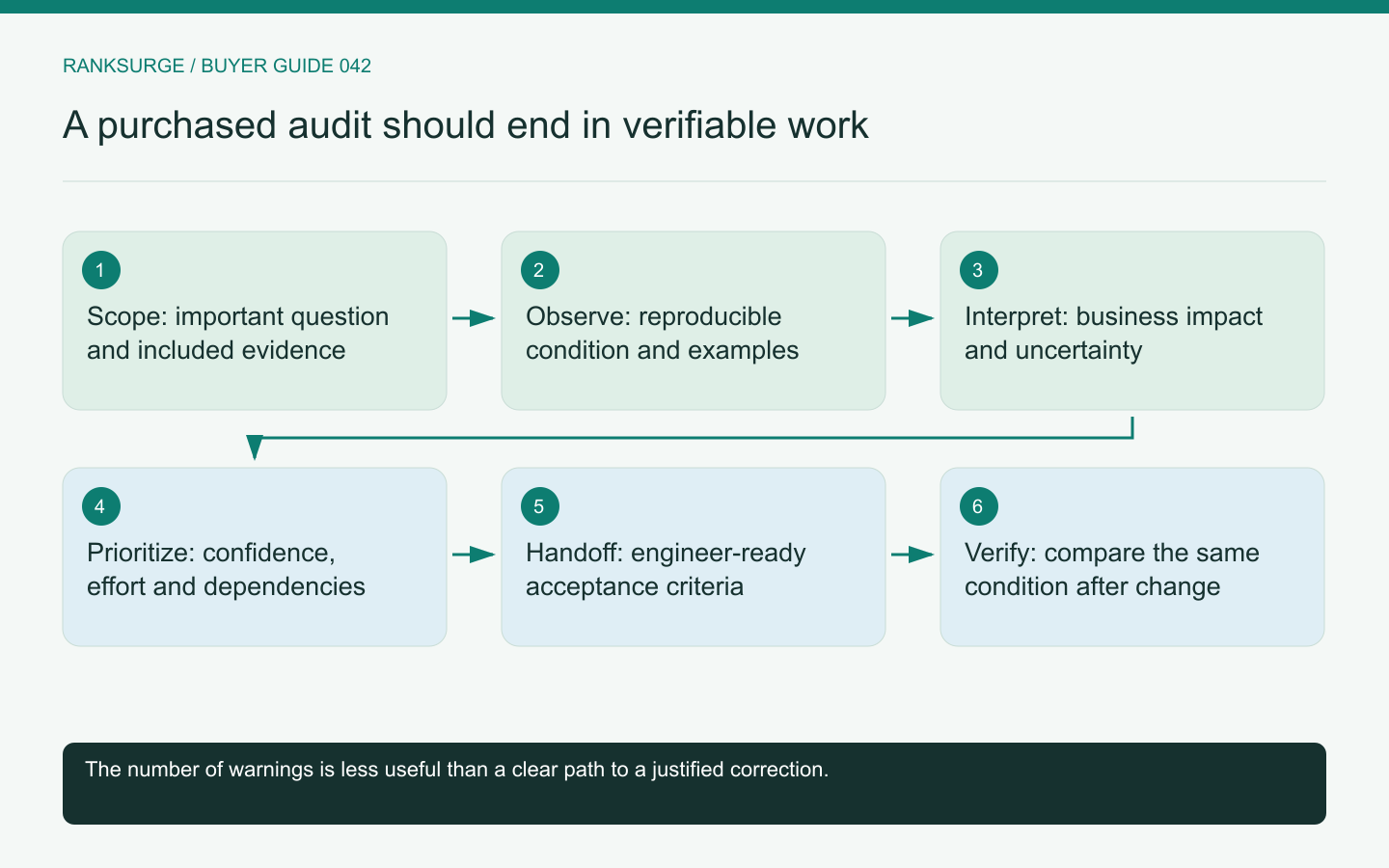
A useful finding includes an observed condition, affected examples, why it matters and the next verification step. The provider should distinguish facts from interpretations. A page returning an unexpected status is observable; the full business impact may require additional context.
Ask for a sample deliverable with identifiers and screenshots or extracted evidence where relevant. Avoid accepting a generic sample that contains only severity labels and broad advice. The actual team needs enough detail to reproduce the observation.
RankSurge's site-audit capability can contribute page-level signals. Those signals are inputs to an audit, not proof that every reported warning deserves immediate engineering work. A qualified reviewer should connect them to the site's intended behavior.
Related reading: SEO for Startups: A Founder’s Handbook.
Related reading: The Best Open Source SEO Tools in 2026 - RankSurge Blog.
Evaluate prioritization against your constraints
Have the provider explain how it ranks recommendations. A repeated template issue may affect many pages, while a single broken commercial page may matter more to the business. Raw counts and generic severity labels do not settle that choice.
Use an illustrative comparison between a minor title-length concern and an important page that cannot be reached through normal navigation. Ask what evidence would make the provider prioritize one over the other. The answer should connect impact, confidence and effort rather than repeat a tool's default order.
Include your team's implementation capacity. A useful audit can propose a small first set of changes and identify dependencies, instead of delivering a backlog too broad for anyone to begin.
Inspect the engineering handoff
Give a sample finding to an engineer who was not involved in the sales discussion. They should understand the affected route or template, the observed behavior and the acceptance criteria for a correction.
A recommendation such as improve internal linking is too vague to implement safely. A bounded proposal identifying an important page group, the missing path and an example of the intended navigation relationship is more useful.
The audit should not prescribe code changes beyond the evidence or ignore product requirements. If a page is intentionally private or a route is deliberately retired, the reviewer needs that context before calling its behavior an error.
Separate recommendations from ranking promises
Search outcomes depend on more than one technical correction. A provider should be able to explain why a change improves the site without promising a guaranteed ranking or traffic result.
Google's helpful-content guidance offers a useful standard for content-related recommendations: they should improve the value and reliability of the page for its audience. Adding words or changing dates without a substantive reason is not a meaningful audit outcome.
Ask how the provider handles uncertainty. Some findings justify a direct repair; others justify further measurement or a limited experiment. The final report should distinguish those levels of confidence.
Include verification in the purchase
Define whether the engagement includes a follow-up review after corrections. If it does, preserve the original scope and evidence so the reviewer can compare the relevant condition rather than run a different scan and report a new score.
Have the provider demonstrate one verification record: original observation, implemented change, new observation and remaining limitation. This creates a useful closure process and reduces the chance that a recommendation disappears into an issue tracker without confirmation.
Choose a deliverable your team can use
Compare proposals on the quality of their investigation, prioritization and handoff, not only the number of checks or report pages. A smaller audit can be valuable when it resolves a specific important question with reproducible evidence.
The purchase succeeds when your team knows what to change, why it is justified and how to determine whether the intended condition improved. Require that outcome in the brief before signing, so the audit becomes a working plan rather than a document everyone acknowledges and nobody implements.