
Broken Internal Links: Prioritize the Journeys Users Still Follow
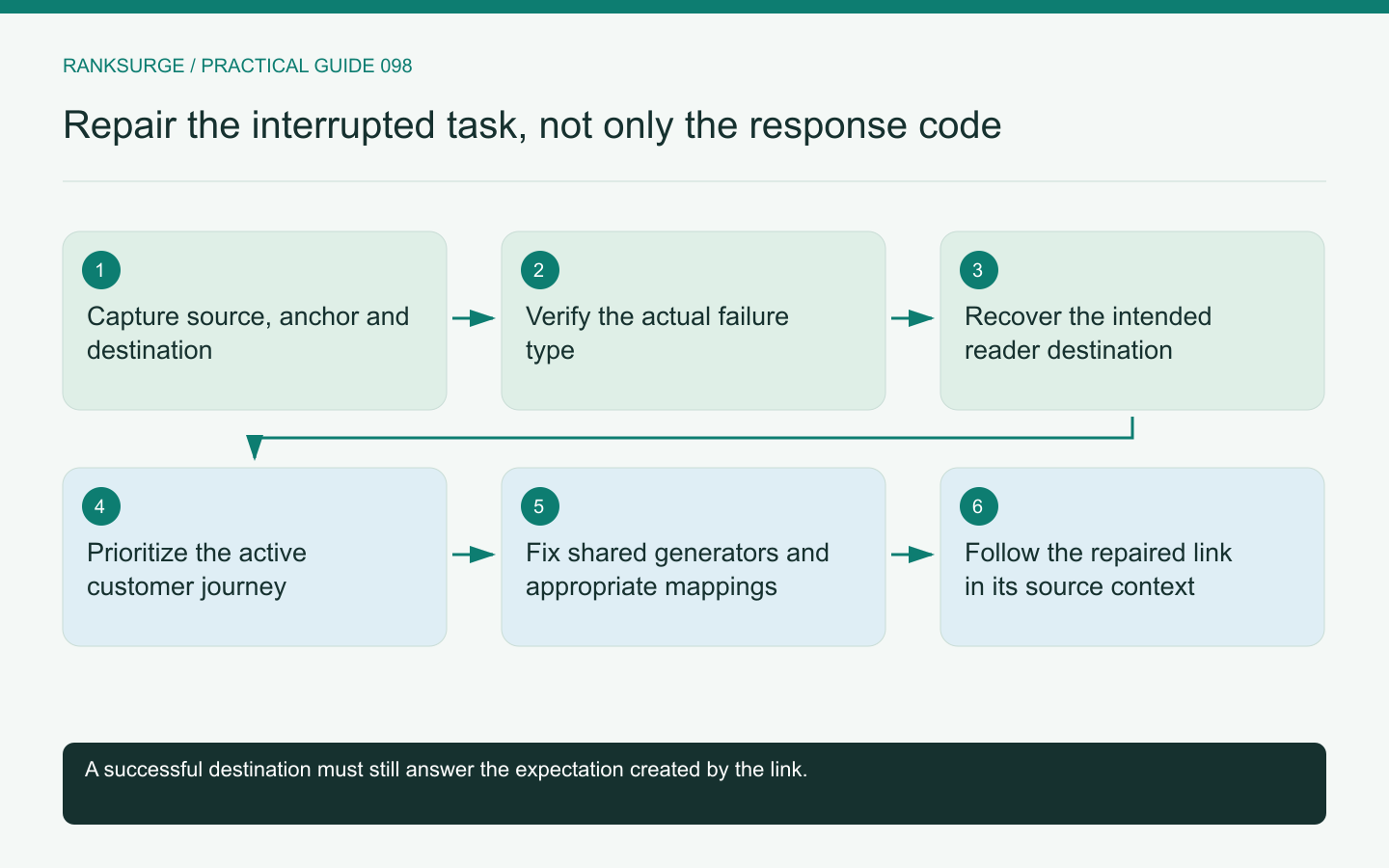
Prioritize broken internal links by the journeys they interrupt, verify the intended destination and correct the source that keeps generating the broken address.
TL;DR
- Prioritize fixing broken links that interrupt journeys people still follow, using actual traffic and product context to decide urgency rather than raw audit counts or invented losses.
- Diagnose each failure from the source: start with the source page, link text, destination and observed response, reproduce representative findings, then recover the intended destination or revise the source.
- Treat fixes deliberately and verify end-to-end: redirects or edits are choices, and a repair is complete only when the route is relevant, reliable and maintained at its source.
A broken link is a failed expectation
An internal link promises that a reader can continue to a relevant resource. When it fails, the important question is what the person was trying to do and how the site should help them continue.
An audit count alone does not reveal that context. A broken checkout-related link, an old reference in a low-traffic archive and a missing optional asset deserve different investigation priorities.
Begin with the source page, link text, destination and observed response. That small evidence set usually explains more than a list of destination URLs without their referring context.
Verify the response and the failure type
Check whether the destination is missing, temporarily failing, restricted, malformed or redirected somewhere unexpected. A protective layer blocking the crawler can produce a different result from an ordinary public browser request.
Keep temporary collection failures separate from confirmed broken destinations. Reproduce representative findings before assigning a broad repair task.
Also inspect pages that return a successful response while displaying an error message. A technically successful status does not necessarily mean the link fulfilled the reader's expectation.
Recover the intended destination
Use the source context and content history to determine what the link was meant to reach. The visible anchor text, surrounding paragraph and previous route mapping can all help.
For an illustrative integration guide, a link labeled “create an API key” should lead to the relevant instructions or account workflow. Sending it to a generic homepage may technically avoid an error while leaving the user unable to complete the task.
If no suitable replacement exists, decide whether to remove the link, revise the surrounding instructions or create the missing resource through the normal content process.
Prioritize the journeys still in use
Identify whether the source page belongs to an important acquisition, evaluation, purchase or support journey. Use actual traffic and product context where available, while keeping unknown impact explicit.
A broken link in a required onboarding step can be urgent even if the page is not an organic-search landing page. Conversely, a repeated link in an obsolete archive may be lower priority unless it still serves an important audience.
Do not invent revenue losses to justify the work. Explain the interrupted task and the evidence that the path remains relevant.
Fix the source of repeated links
Many broken links originate in a shared navigation component, CMS field or reusable content block. Group the affected source pages by the mechanism generating the address.
A single correction to a shared component can repair many pages, but it also needs a representative regression check. Confirm that other links generated by the component still reach their intended destinations.
For editor-authored links, inspect whether a copied preview URL or old slug is the recurring pattern. A clearer publishing workflow may prevent future errors more effectively than repeatedly cleaning the audit output.
Choose redirects and direct edits deliberately
A redirect can preserve access for old external references, while direct edits can stop the current site from publishing obsolete paths. These are complementary decisions rather than mutually exclusive fixes.
Google's redirect guidance is the technical reference for appropriate move behavior. Apply it to a relevant destination, not as a reason to redirect every missing address indiscriminately.
When the content was intentionally retired without an equivalent replacement, preserve an honest outcome. The surrounding source page may need an editorial change rather than a misleading redirect.
Check fragments and contextual destinations
A page-level request can succeed while a link to a specific section no longer works as intended. If the source promises a subsection, verify the fragment target and the content it identifies.
This matters for long documentation and policy pages where a reader expects to arrive near the relevant answer. A heading rename can break that convenience without appearing as a conventional missing-page error.
Keep fragment checks distinct from route checks so the implementation owner understands whether the fix belongs in the link, the destination heading or a stable anchor policy.
Keep link text aligned with the replacement
When a resource is replaced by a broader guide, revise the anchor and surrounding sentence if necessary. A destination can be relevant without matching the original promise exactly. Updating that promise helps the reader understand what they will find and prevents a technically repaired link from remaining editorially misleading.
Verify from the source page after repair
Follow the corrected link in its actual context and confirm the destination answers the expected question. Then rerun the affected audit set and check that the old broken address is no longer generated where it should have been replaced.
RankSurge can help identify the pattern, but the final validation should include the reader's journey. The repair is complete when the route is relevant, reliable and maintained at its source—not merely when one response code disappears from an issue table.
Related reading: SEO for Startups: A Founder’s Handbook.
Related reading: The Best Open Source SEO Tools in 2026 - RankSurge Blog.