
Before Canceling an SEO Tool: Export Baselines and Preserve Monitoring Context
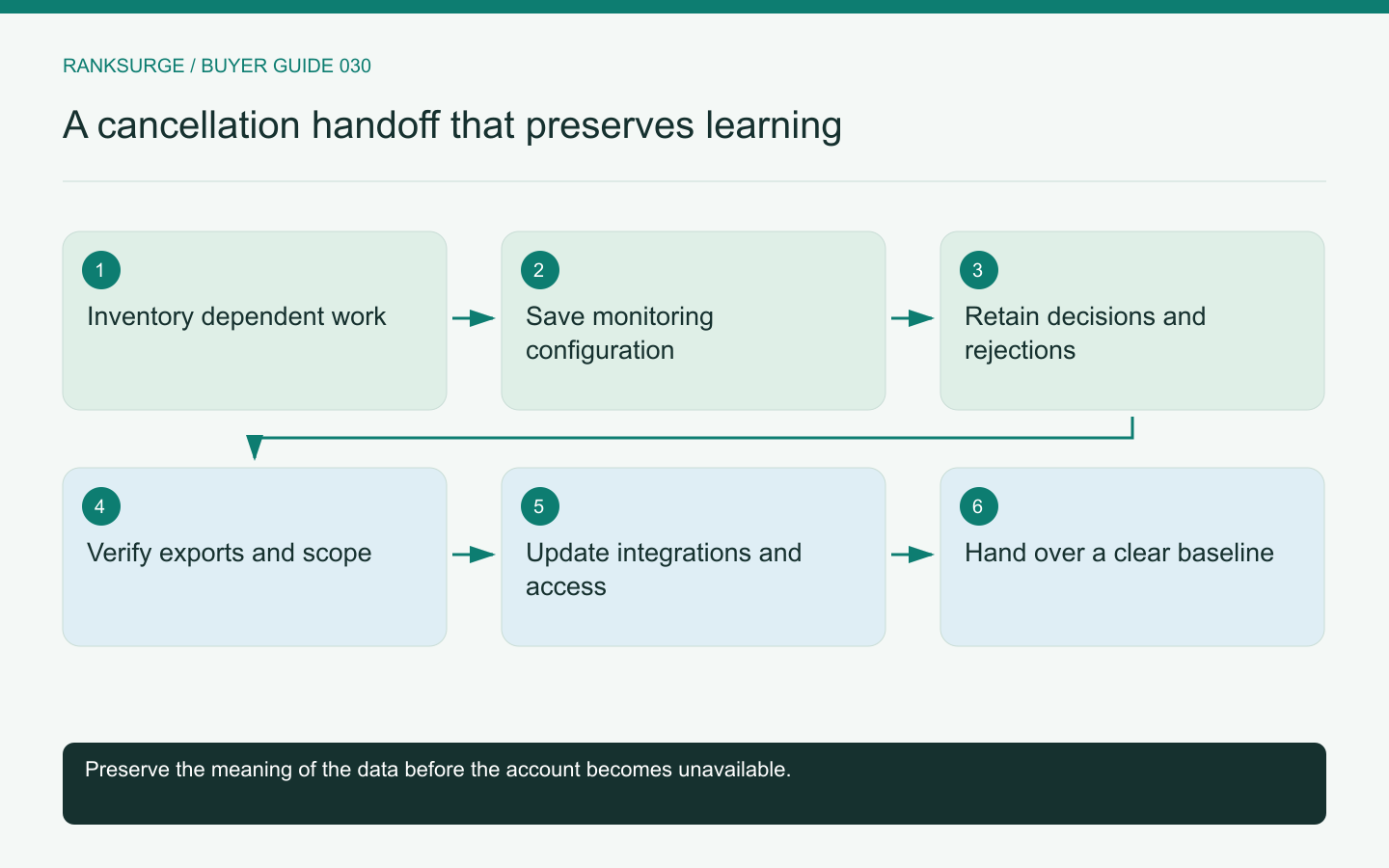
Before canceling an SEO tool, preserve research decisions, monitoring settings and report context so the next workflow starts with an understandable baseline.
TL;DR
- Before canceling, preserve the reasoning and key assets from the SEO tool—export necessary context, settings, and historical evidence while access still works to avoid missing filters or administrator-only records.
- Use an inventory-plus-export method: list saved keywords, reports and integrations, export monitoring settings with observations, and verify files open in the tool the team will use before deletion.
- Confirm a usable handover by assigning ownership and performing a continuity test: someone unfamiliar must explain the next action and historical caveats; if they need account reopening, the handover fails.
Cancel the subscription without losing the reasoning
An SEO tool can contain more than data rows. It may hold the explanation behind a content plan, the settings of a rank tracker and the historical evidence used in client reports. Before cancellation, identify which of those assets your team needs to retain.
Start while access still works. A rushed final export can miss filters, relationships or records that require an administrator. The objective is not to archive every available screen; it is to preserve enough context to continue useful work and explain past decisions.
Check the provider's current cancellation and access terms directly. Do not assume that all services keep the account available for the same period.
Inventory the work that depends on the account
List saved keywords, research notes, competitor lists, reports, crawl histories and monitoring configurations. Add connected properties, scheduled exports and shared links used by clients or teammates. Identify the owner and future destination of each item.
Separate active work from historical evidence. An unfinished content plan may need to move into the next system. A completed audit may belong in a dated archive. A temporary experiment may no longer need to be retained, subject to the organization's requirements.
This classification reduces clutter and prevents old research from silently becoming current advice in the replacement workflow.
Preserve monitoring configuration before the numbers
A ranking history is difficult to interpret without the query, market, device and tracked domain or URL assumptions. Export or record those settings alongside the observations. Note any changes that affect comparison over time.
If the next tool uses different data or definitions, keep the source change visible in future reports. Do not merge two series into one continuous graph merely because both columns are labeled position or visibility.
For a representative keyword, ask a teammate to reconstruct the old configuration from the saved package. If they cannot, improve the record before account access ends.
Keep selected and rejected research
The chosen keywords are valuable, but rejected candidates can save future work too. Preserve the reason a tempting topic was excluded: unsupported product capability, wrong audience, overlap with an existing page or insufficient evidence.
A simple decision note can carry more useful context than a large raw export. Include the intended page, audience, market and condition under which the topic should be revisited. This helps the next researcher avoid treating every old row as a fresh opportunity.
If a saved report depends on external links, confirm the important evidence remains accessible or retain an appropriate summary. Do not copy restricted or unnecessary content merely to make the archive larger.
Verify exports while you can compare them
Check record counts, date coverage and representative relationships against the live account. Open the files in the tool your team will actually use. Inspect missing values, non-Latin text, line breaks and URLs rather than assuming a successful download proves completeness.
Write a readme describing the export date, filters, source and known gaps. Keep the export creation time separate from the dates of the underlying observations.
If a download link expires, save the required file in the organization's approved storage before the deadline. Avoid leaving the only copy in an employee's downloads folder or a temporary chat attachment.
Update integrations and shared workflows
Identify reports, agents or scripts that still call the old service. Decide which should be disabled, reconfigured or retained until the transition is complete. Remove credentials through the appropriate account process when they are no longer needed.
Notify the relevant internal owners when a client-facing report link or scheduled deliverable will change. Do not assume the cancellation itself updates every downstream reference. A technically successful account closure can still break a reporting commitment.
For a replacement tool, run a small parallel task to verify the new connection and output before retiring the old path. Keep the scope controlled so the overlap does not create unnecessary duplicate spending.
Read the account-specific terms
RankSurge's pricing page explains its cancellation and access policy. Use the current terms for the service you are actually leaving, including any negotiated agreement. A renewal cancellation and immediate account deletion may have different consequences.
Have the authorized account owner perform the commercial change and retain the confirmation. Keep payment details and credentials out of the general transition report. The report should identify the action and effective date without exposing sensitive account information.
If any essential export remains unresolved, address it before intentionally ending the access needed to retrieve it.
Related reading: The Best Open Source SEO Tools in 2026.
Related reading: SEO for Startups: A Founder’s Handbook.
Hand over a usable baseline
The final package should contain active plans, necessary historical evidence, monitoring settings and a short explanation of what changed. Assign a person to own the new workflow and record its first comparable observation date.
Ask someone who did not prepare the package to explain the next planned action and the most important historical caveat. That is a practical continuity test. If the answer requires reopening the canceled account, the handover is not finished.
Canceling an SEO tool should end a commercial relationship, not erase the team's learning. A deliberate export and transition process preserves the reasoning that made the software useful while giving the next workflow a clear, honest starting point.