
Backlink Prospecting Software: Compare Qualification Work, Not Contact Counts
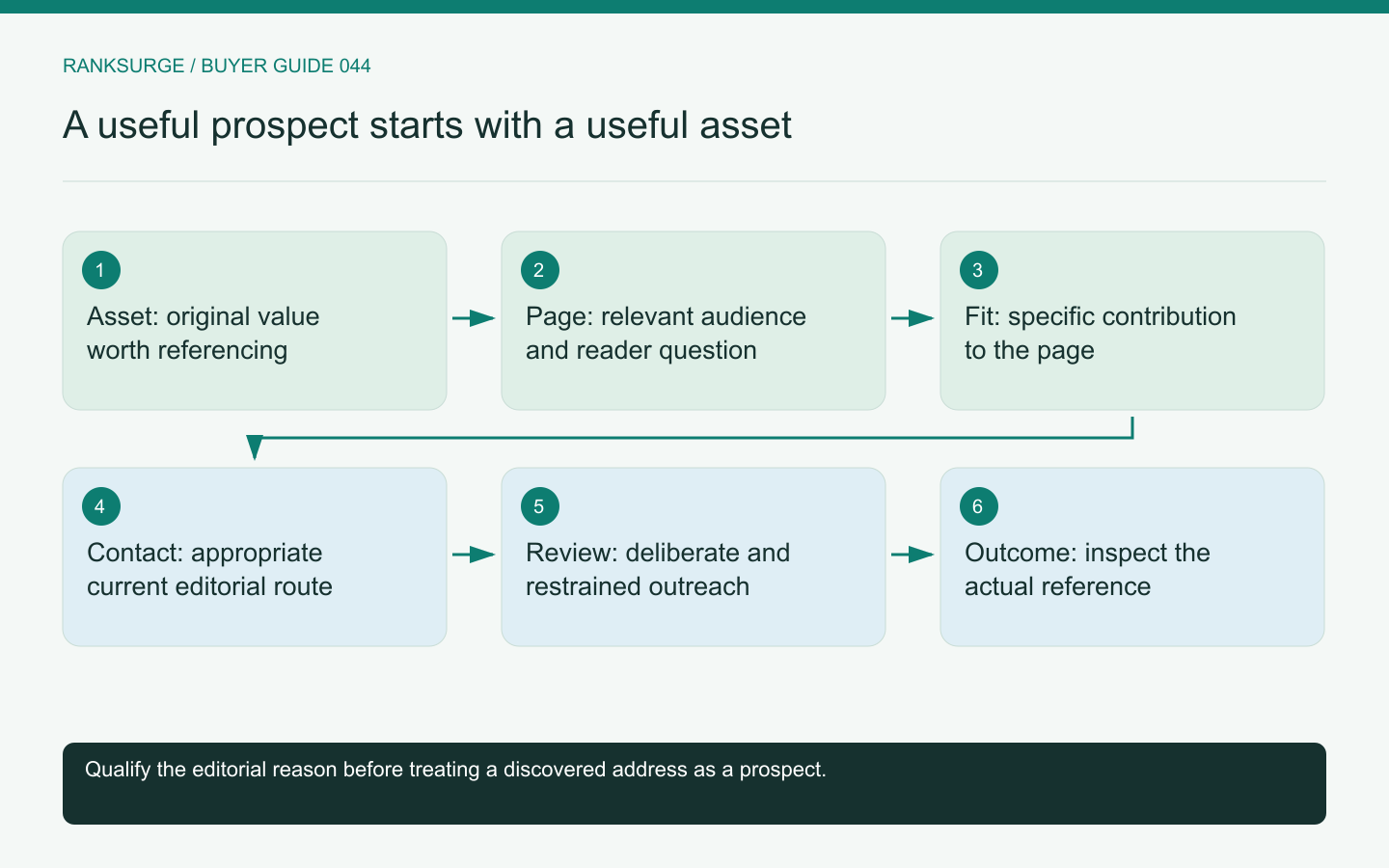
Compare backlink prospecting software using page relevance, editorial fit, contact accuracy and human review rather than raw prospect or email counts.
TL;DR
- Prioritize qualification effort over raw contact counts: measure review work, inspect pages, and avoid treating every discovered row as equally valuable when choosing backlink prospecting software.
- Begin with a concrete asset and require tools to return inspectable prospects for that same asset; preserve source pages and stated editorial reasons to streamline human qualification and rejection.
- Verify outcomes by inspecting actual pages and links; expect a successful workflow to yield a small set of relevant, verifiable references rather than broad, automated outreach counts.
Define the asset before the prospect list
Backlink prospecting software can help discover pages and publishers that might find your work useful. Its value depends on the quality of the asset you want them to reference and the relevance of the match. A large contact list does not solve either problem automatically.
Start with a real resource: an original dataset, a useful technical explanation, a maintained tool or another page with a clear contribution. Write one sentence explaining who would benefit from citing it and why. If that sentence is vague, improve the asset before buying a larger prospect database.
Compare page-level relevance
Ask each candidate to return a small set of prospects for the same asset. Review the actual pages, not only the domains' third-party scores. A high-scoring website can contain an irrelevant page, while a smaller specialist publication may serve exactly the audience that needs your resource.
For an illustrative email-authentication explainer, a page teaching domain setup might have a relevant reason to cite it. A generic business directory does not become a strong match merely because the software finds an available submission form.
Require the tool to preserve the source page and the reason it was shortlisted. This makes later review more efficient and prevents prospect lists from becoming disconnected collections of domain names.
Inspect whether the proposed contribution is real
Open the prospect page and identify the reader question your asset would answer. Is there an outdated reference, an incomplete explanation or a genuine opportunity to add useful evidence? Do not invent a problem simply to justify outreach.
The prospecting tool should make it easy to reject weak matches and record why. A workflow that treats every discovered page as a contact target encourages volume over judgment.
RankSurge's MCP documentation includes backlink research and link-prospecting workflows. Evaluate the evidence those tools provide, while keeping editorial qualification and any communication decision under deliberate human review.
Related reading: SEO for Startups: A Founder’s Handbook.
Related reading: How to Prompt Claude Code for SEO.
Distinguish link research from link schemes
Google's spam policies identify manipulative link practices, including excessive exchanges and automated link creation. A software purchase should not be justified by promises to manufacture ranking credit through those mechanisms.
Relevant outreach can introduce useful work to an editor, who remains free to decide whether to reference it. Paid promotion and sponsorship have their own disclosure and link-qualification requirements. Do not let a prospecting platform blur those different activities into one generic acquisition count.
Ask the vendor what its automation actually does. Discovering possible pages, drafting a message and placing a link are different actions with different controls. Buy research assistance without assuming unattended external action is necessary.
Test contact accuracy and restraint
A contact address may be public but still be inappropriate for the proposed message. Ask how the tool identifies the relevant editor or submission route and how it labels uncertain matches.
Use a small reviewed sample. Check whether the contact belongs to the current publication, whether the site provides a preferred process and whether the message would reach someone responsible for the page. An old generic address is not high-quality evidence merely because it passes a format check.
The workflow should also preserve prior contact and do-not-contact decisions. Repeated outreach from different team members can damage a relationship even when each individual message looks reasonable in isolation.
Compare review effort, not only discovery speed
Measure how long your team needs to qualify a sample prospect from each tool. Record the reasons for rejection: irrelevant page, stale site, unsuitable contact, weak asset fit or unsupported data.
A platform that returns fewer but more inspectable candidates may reduce total work. Another may be useful for broad discovery but require substantial manual filtering. Price those roles honestly instead of comparing raw row counts as if every row were equally valuable.
Do not invent an acceptance rate from a vendor's demo. If you run your own sample review, label the result with its size, selection method and limitations. A narrow trial can guide your purchase without becoming a universal benchmark.
Before contacting anyone, recheck that the asset is still current and publicly usable. A strong prospect match can become weak if the resource has moved, requires unexpected access or no longer supports the specific claim you want an editor to reference.
Verify outcomes without overstating them
If a publisher later references the asset, inspect the actual page and link. A discovered link, an indexed page and referral traffic are different observations. Search Console's Links report documentation explains the nature of that report; it should not be treated as a complete real-time record of every external reference.
Choose software that helps preserve the relationship between asset, prospect, editorial reason and observed outcome. The useful result is a small set of relevant relationships and verifiable references. A large automated outreach queue is not, by itself, evidence of a successful backlink strategy.