
Backlink Analysis Tool Selection: Evaluate Coverage and Useful Evidence
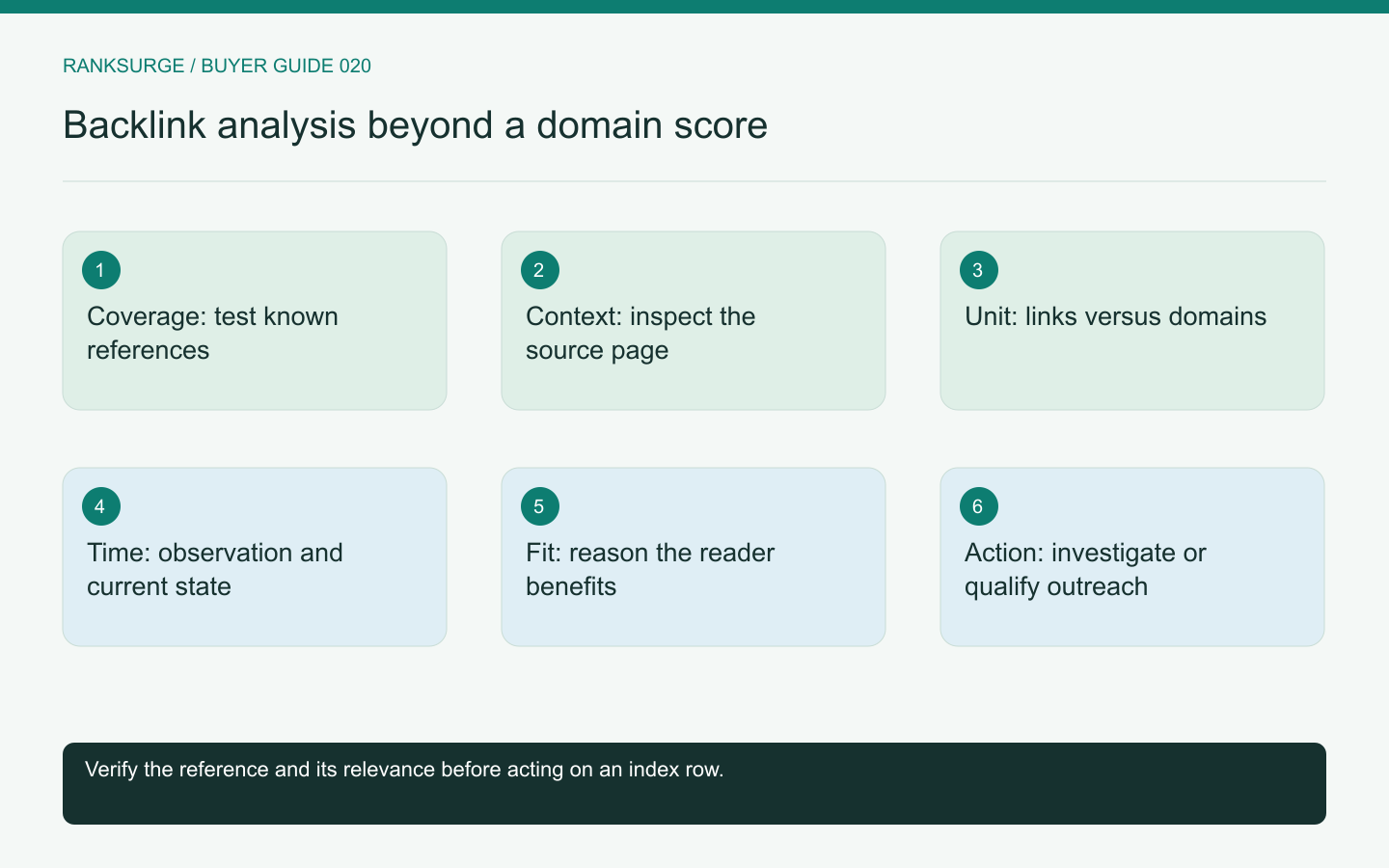
Evaluate backlink analysis software through coverage, link-level evidence, freshness and the decisions your team can make from the results.
TL;DR
- Decide on the decision the data must support and pick the tool that enables defensible recommendations rather than valuing index size alone.
- Validate coverage by testing known references and inspecting row-level meaning—confirm referring page, target, anchor context and attributes before trusting aggregate metrics.
- Treat freshness and verification as a required success check: reconstruct timelines for lost links, record observations, and include manual verification and real cost in final comparisons.
Decide what backlink evidence you need
Backlink tools can help investigate a site's references, study competitor patterns or qualify outreach ideas. Those tasks require different levels of detail. A domain-level total may be enough for an initial overview, while a lost-link investigation needs the referring page, destination and current context.
Before comparing products, name the decision the data should support. “Understand which publishers cite useful resources in our market” is more actionable than “get more backlinks.” The clearer task makes it easier to evaluate coverage and avoid treating a large index as a guarantee of useful recommendations.
No third-party index should be assumed to contain every link on the web.
Test known references before exploring unknown ones
Choose several links you already know about, including different page types and ages. Ask each candidate tool to retrieve the relevant evidence and record what it finds, what it misses and when the records were observed. This is a small coverage sample, not a definitive benchmark of the provider's entire index.
Open the source pages yourself where accessible. Confirm that the link still exists and points to the expected destination. A database row may describe a previous state, and a changed page can alter the meaning of the reference without changing the domain.
Use the sample to understand limitations rather than declaring a universal winner from a handful of results.
Inspect link-level meaning
A useful row should help you identify the referring page, target page, anchor context and relevant attributes. The surrounding content matters: a citation in a substantive guide is different from an automatically generated directory entry, even when both originate from the same domain.
Ask whether the interface makes it practical to inspect that context. If it only encourages sorting by a single authority score, your team may need another workflow to judge relevance and editorial value.
Do not treat a domain score as a direct instruction to pursue a link. The reader relationship and the reason your page deserves a reference should remain part of the decision.
Distinguish links from referring domains
Several links from one site and single links from several sites describe different patterns. Neither pattern is automatically better without context. A useful product documentation partnership may produce many legitimate references from one domain; a large count of unrelated domains may add little insight.
During evaluation, group a sample by referring domain and inspect the pages within each group. Determine whether counts include repeated site-wide elements or distinct editorial references. Ask how the provider defines and updates those counts.
Keep the definitions with exported data. Otherwise a report comparing two tools can accidentally compare different units while presenting the numbers as equivalent.
Evaluate freshness for investigations
A lost-link alert should trigger verification, not immediate outreach. The source page may have moved, the target may redirect or the collection process may have failed to revisit the page successfully. Ask how the tool distinguishes those possibilities and what evidence it exposes.
Use a historical example during the trial and reconstruct the timeline. Record the last known observation, the reported change and the current page state. Avoid claiming that the exact moment of loss is known if the evidence only establishes a window between crawls.
For competitor research, older data may still reveal useful publisher patterns, but the outreach candidate must be checked before contact. Different tasks have different freshness requirements.
Check what the chosen platform actually exposes
RankSurge's feature overview includes backlink research. In a buying evaluation, verify whether its available view provides the overview or row-level evidence required for your specific task. Do not infer a full outreach database, contact discovery or automatic link placement from the presence of a backlinks feature.
If another tool supplies deeper records, compare the additional cost with the work those records enable. A lightweight overview may be enough for a founder's initial diagnosis. An analyst investigating individual lost references may need more detailed history and exports.
Make the limitation explicit in your workflow so a summary metric is not later used as evidence for a claim it cannot support.
Related reading: SEO for Startups: A Founder’s Handbook.
Related reading: The Best Open Source SEO Tools in 2026.
Test a useful outreach decision
Select one potential publisher from the research and write why its readers would benefit from your asset. Verify the relevant page and discover a contact path from an authoritative source. If there is no clear editorial reason, reject the prospect even if its metrics look impressive.
This exercise tests whether the tool helps narrow the work to plausible opportunities. It does not require sending any message during the trial. Keep research authorization separate from outreach authorization.
Avoid measuring success by the number of email addresses collected. A smaller set of qualified, source-backed prospects can be more useful than a large list with no reason for inclusion.
Choose evidence that supports the intended action
Your final comparison should state the task, observed coverage sample, freshness limitations, export context and manual verification required. Include the actual cost of producing a reviewed recommendation, not just the subscription fee.
Choose the backlink tool that helps your team explain the relationship behind the count. The most useful output is a defensible investigation or a credible editorial opportunity. A larger number on a dashboard is context, not the decision itself.