
An SEO Tool Procurement Questionnaire for Research and Monitoring
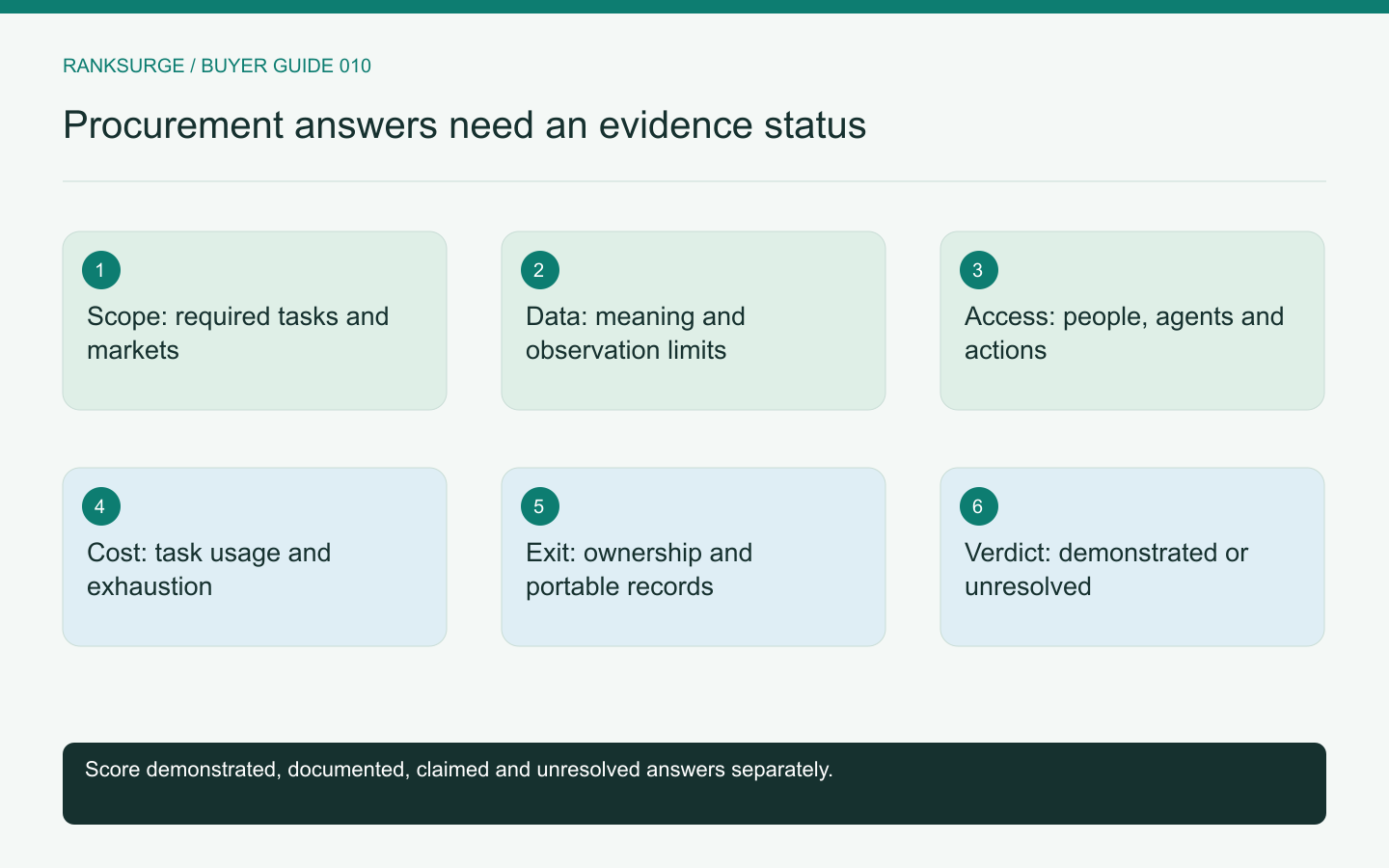
Use an SEO procurement questionnaire that asks vendors for demonstrations, definitions and account terms instead of unsupported yes-or-no feature claims.
TL;DR
- Decide only when evidence supports tradeoffs: a procurement questionnaire is complete when it enables a purchase decision with explicit tradeoffs, not a checkbox of features.
- Prefer demonstrated workflows and sample outputs over vague yes/no claims; request reviewable examples that reveal scope, ownership and limitations before subscribing or contracting.
- Define a pass/fail rubric and verify continuity: score vendor answers by evidence quality and test exports to confirm ownership, portability and interpretability before relying on the tool.
Ask questions that produce verifiable answers
An SEO procurement questionnaire should reduce uncertainty about the work you plan to perform. A long checklist of feature names often produces a column of yes answers without explaining scope, limitations or ownership. Replace vague questions with requests for a sample output or a demonstrated workflow.
For example, “Do you support competitor research?” is less useful than “Show the source, market and observation date for a competitor keyword row, then export it.” The second request makes the answer reviewable. It also helps your team discover which details matter before a contract or subscription becomes difficult to change.
Related reading: The Best Open Source SEO Tools in 2026.
Begin with business scope
Describe the websites, markets, users and recurring tasks the platform must support. Distinguish required work from possible future work. A team researching one product in one market should not evaluate every enterprise capability as though it were immediately necessary.
Ask the vendor which parts of your described workflow are supported, which need another service and which have not been demonstrated. Request a clear answer for each requirement rather than accepting a general statement that the platform is flexible.
An illustrative scope might include monthly keyword qualification, weekly monitoring and occasional technical investigations. The vendor's answer should address that workload, not merely show the largest plan's headline limits.
Ask about data meaning and coverage
For keyword and competitor data, request the source, supported markets, update context and treatment of unavailable values. Ask how estimated traffic differs from first-party performance. For rankings, ask which location, device and result type each position describes.
For a site audit, ask how pages are discovered, what is excluded and whether browser rendering or performance sampling is involved. Request an example of the full affected-URL evidence behind an issue summary. The goal is to understand what the tool observed, not simply how severe it labeled the finding.
Write down unreturned answers as unresolved. Do not convert silence into an assumption that the platform behaves like the one you currently use.
Ask about actions and permissions
List the actions users or agents can perform: read research, save keywords, change project context, manage connections, modify monitoring and administer billing. Ask which roles can perform each action and how access is revoked.
If the platform offers an API or MCP server, evaluate those permissions separately from the visual interface. A personal key may act with the account holder's authority. Ask how credentials are created, rotated and removed, and who can audit their use. Never put a real key into the procurement worksheet.
RankSurge's MCP documentation describes both OAuth and personal API-key access. That is a reason to include agent access in the evaluation, not a reason to assume all desired permission boundaries are available. Verify the boundaries your organization requires.
Related reading: SEO for Startups: A Founder’s Handbook.
Ask for a cost model tied to your work
Provide representative task sizes and frequencies. Request the applicable plan, operation costs or limits, and behavior when capacity is exhausted. Ask whether unused allowance rolls over and whether an overage can occur automatically.
Separate subscription price from optional services, data-provider accounts, implementation work and taxes. For self-hosting, identify who owns infrastructure, backups, upgrades and provider billing. A software license or open-source repository does not eliminate those operating responsibilities.
Use the live quote or checkout as the financial source of truth. Preserve its date and billing currency. If an allowance is described in credits, ask for enough task-level detail to compare completed work rather than comparing raw credit counts across vendors.
Ask about continuity and exit
Request the account ownership model, cancellation behavior, export options and access after the paid period ends. Ask how you retain project configuration and historical evidence if the original administrator leaves.
Test a small export containing multiple markets, missing values and decision notes. Verify whether another teammate can interpret it without the source interface. If some records require separate exports, document the procedure and the person responsible.
For a tool that will support client work, ask how one project's material can be handed over without exposing another project's information. This should be a demonstrated workflow or a clearly documented limitation, not a promise inferred from the word “workspace.”
Score answers by evidence quality
Use four statuses: demonstrated, documented, claimed and unresolved. A demonstration proves a specific tested behavior; documentation describes the vendor's stated behavior; a sales claim may still need verification. These categories are more informative than treating every positive answer as equivalent.
For each must-have requirement, name the reviewer and acceptance condition. An engineer may review exports and access; a researcher may review data meaning; the account owner may review billing. Keep the final decision concise enough that all three can see the remaining gaps.
A procurement questionnaire is complete when it supports a purchase decision with explicit tradeoffs. You may accept a limitation because a workaround is inexpensive, or reject an otherwise strong tool because one requirement is essential. The important point is that the decision rests on evidence your team can revisit, rather than a checklist that no one can explain.