
AI Visibility Monitoring Tools: Evaluate Sampling and Evidence Before Buying
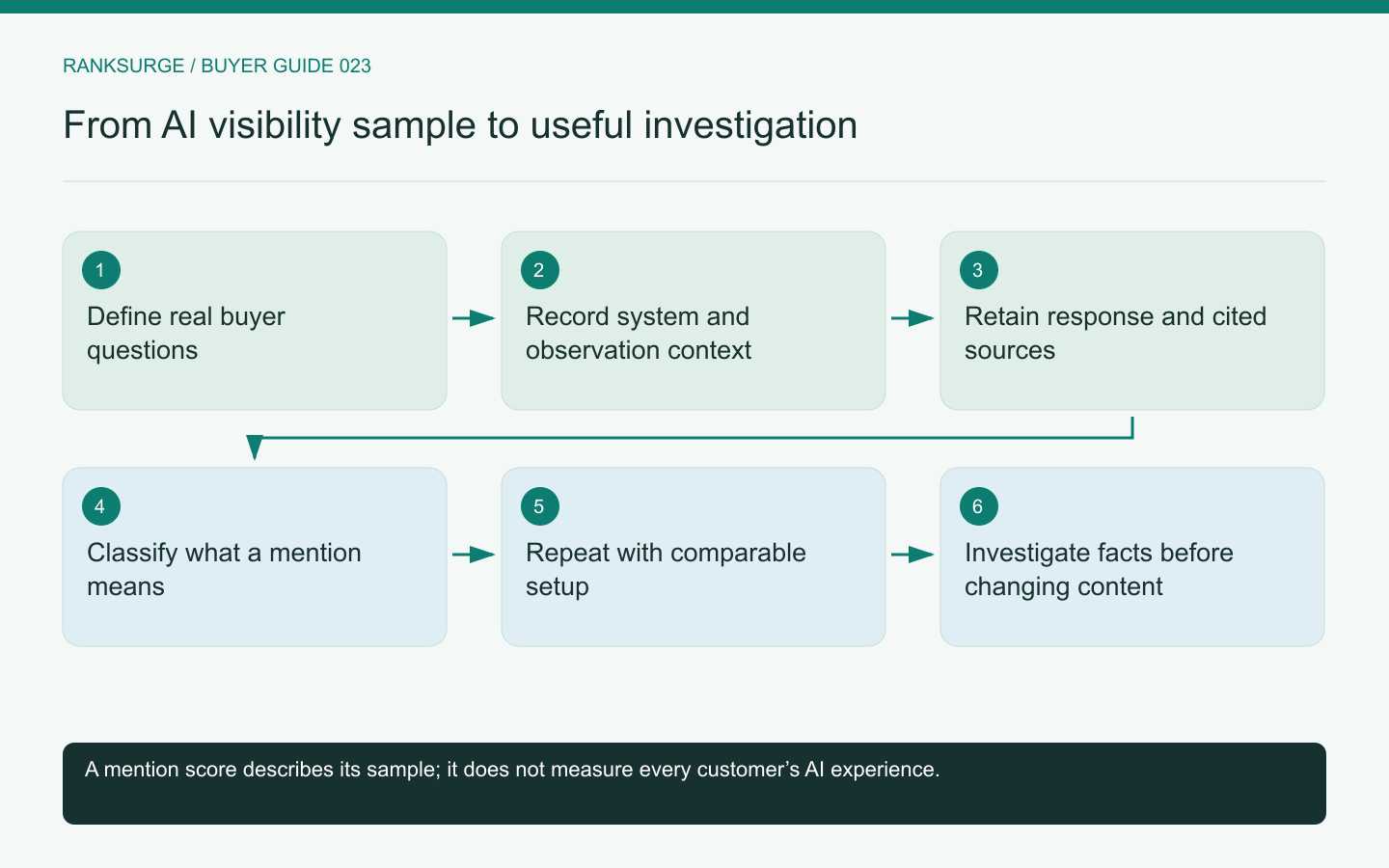
Compare AI visibility tools by their prompt samples, response evidence and repeatability, without treating a brand-mention score as a market-wide measurement.
TL;DR
- Decide whether to buy an AI visibility tool by inspecting what the visibility score actually samples and ensuring the product exposes underlying evidence your team can challenge.
- Use a small, deliberate prompt set based on real buyer questions—separate branded from unbranded queries and record audience and why each answer matters to your business.
- Check measurement limits by testing repeatability, asking for denominators behind percentages, and keeping model- or system-specific results separate before blending scores.
Ask what the visibility score actually samples
AI visibility tools can observe whether a brand appears in generated answers, but the result depends on the questions, systems and timing sampled. A dashboard score is not self-explanatory. Before buying, ask which observations produce it and which parts of the wider search experience it does not represent.
Begin with the decision you want to make. You may want to inspect how a product is described, whether a source page is cited or whether a competitor appears in a particular buying question. Those are more concrete tasks than trying to maximize an undefined visibility percentage.
The product should expose enough underlying evidence for your team to challenge the summary.
Define a prompt set around real buyer questions
Create a small set of questions that reflect distinct stages of evaluation: category discovery, comparison, implementation constraints and a specific use case. Avoid filling the set with near-identical wording merely to increase the number of observations.
For each prompt, record the intended audience and why the answer matters to your business. A question asking for an enterprise solution may be irrelevant to a product built for individuals, even if a brand mention would look positive on a chart.
Keep branded and unbranded questions separate. Asking directly about your company measures a different behavior from asking for suitable products without naming any vendor.
Inspect complete responses and sources
Ask the tool to retain the actual answer, observation time, target system and any cited pages it can expose. A binary mentioned-or-not field loses important context. The brand may be recommended, criticized, confused with another entity or listed without explanation.
Read a few responses manually and classify what the mention means. Verify factual product descriptions against current first-party documentation. If a response cites an obsolete page, that may suggest a content investigation; it does not establish that editing the page will immediately change every future answer.
Distinguish a citation to your site from a mention of your brand. They can occur independently and support different conclusions.
Test repeatability without demanding identical answers
Repeat selected prompts under the same documented setup. Observe whether the tool preserves comparable conditions and makes variation visible. Generated responses can vary, so one favorable answer should not be treated as a stable market position.
Ask which settings the provider controls and which remain opaque. Do not assume that an API-based observation exactly reproduces every consumer interface or personalized session. The tool should explain its collection method well enough for you to understand the limitation.
A useful comparison evaluates the consistency of the measurement process, not an unrealistic promise that every answer will be identical.
Review aggregation and denominators
If the product reports a percentage, identify the denominator. Is it the number of prompts, successful observations, responses containing any brand or something else? Ask how failed requests and unavailable systems affect the score.
Imagine ten planned checks, eight completed responses and two failures. A mention in four responses could be presented against different denominators. The report should make its choice explicit rather than hiding missing observations inside a clean percentage.
Keep model or system-specific results separate before combining them. A blended score can obscure a meaningful difference between surfaces, especially if the sample sizes are unequal.
Evaluate product fit without assuming a publishing engine
RankSurge's feature overview includes AI visibility capabilities. In a trial, inspect the actual supported surfaces, prompts and returned evidence. Do not infer that a monitoring feature automatically writes content, changes third-party answers or guarantees inclusion.
Ask the platform to support one investigation: a response describes an outdated limitation of your product. The useful output is the observed statement, supporting or cited sources and a proposed verification path. Your team still needs to decide whether the problem is inaccurate documentation, ambiguous positioning or something outside your control.
Keep any content change tied to factual improvement for readers rather than a promise to manipulate a particular answer.
Related reading: Two Surfaces, Two Timelines.
Related reading: The Best Open Source SEO Tools in 2026.
Compare cost with useful learning
A large prompt set can create an expensive monitoring routine without producing actionable insight. Start with questions that could change a decision and add coverage deliberately. Record the cost of repeated observations and the human time required to review them.
Ask a teammate to interpret the report without seeing the dashboard demo. They should be able to explain what was sampled, what changed and what remains uncertain. If the only conclusion is that a score moved, the workflow may need better questions rather than more checks.
Choose the tool that preserves evidence and makes its sample boundaries clear. AI visibility monitoring is most useful as a structured observation practice. It should help your team investigate specific descriptions and citations while resisting the temptation to present a small set of generated responses as a complete measure of market awareness.