
Ahrefs Alternatives for Small Teams: Identify the Research Jobs You Need
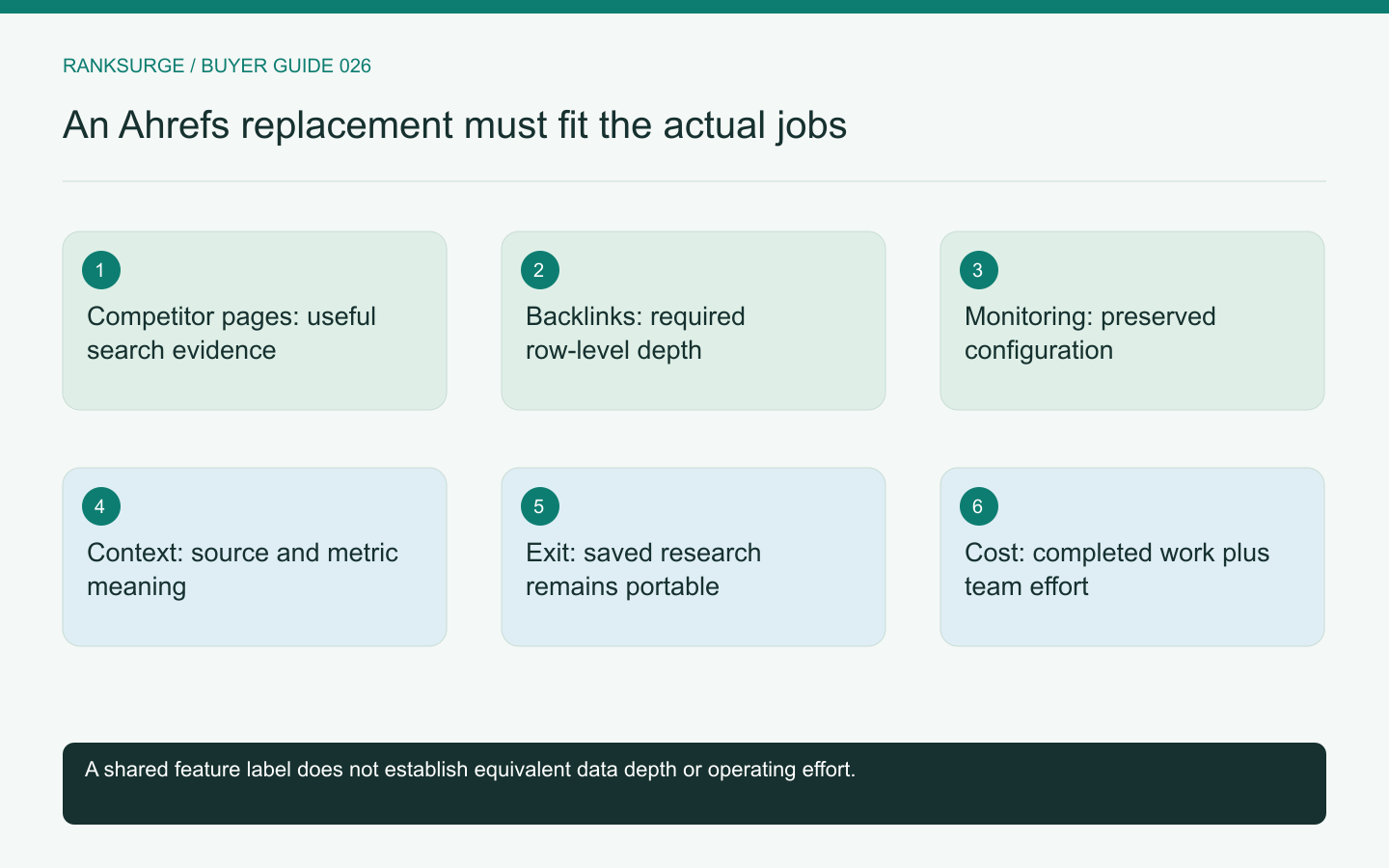
Shortlist Ahrefs alternatives by identifying the research jobs your small team needs, then test coverage, context and total operating effort.
TL;DR
- Decide by replacing the workflow you need, not by swapping brand names; pick the alternative that completes your important research jobs with clear evidence and manageable operating cost.
- Use actual usage and focused tests: review a normal month of usage, build a short conditional shortlist, then test one competitor page deeply to compare the evidence each tool produces.
- Validate portability, metrics and cost: export saved keywords and monitoring configuration, run the new workflow in parallel, and compare cost of completed work before switching.
Replace a workflow, not a brand name
Looking for an Ahrefs alternative is useful when you can name the work you need to preserve or improve. A small team may rely on competitor research, backlink investigations, keyword discovery or recurring monitoring. Those jobs overlap, but a tool that handles one well is not automatically a complete replacement for the others.
Start by reviewing a normal month of usage. List the reports that led to a decision and the features nobody used. This gives you a requirements baseline that is more useful than comparing every checkbox across large product suites.
This is a documented-capability shortlist and evaluation method, not a hands-on benchmark or a claim that one platform has a universally superior index.
Understand the current baseline
Ahrefs' Site Explorer presents competitor research across organic search, backlinks and paid traffic. If your team uses those areas together, an alternative should be tested against the same combined task. If you use only a narrow subset, a smaller workflow may be sufficient.
Record the specific evidence you depend on: page-level keyword rows, referring pages, historical observations or exported research. A summary dashboard may not replace a detailed investigation even when both products list competitor analysis as a feature.
Do not assume a replacement needs identical terminology. It needs to support the decisions your team actually makes with an acceptable amount of additional work.
Build a short, conditional shortlist
Semrush's SEO toolkit is a candidate when you want another broad SEO research environment. Evaluate the relevant modules and current plan rather than assuming everything shown across the wider platform is included in one subscription.
RankSurge's feature set is a candidate when your priorities include research, monitoring and agent-connected workflows. Verify the depth of the particular data view you need. A backlink overview should not be assumed equivalent to every link-level or historical investigation available elsewhere.
You may also decide to combine a focused research tool with first-party Search Console data. That can fit a small team whose main task is improving existing pages, but it will not reproduce third-party competitor intelligence by itself.
Related reading: SEO for Startups: A Founder’s Handbook.
Related reading: The Best Open Source SEO Tools in 2026.
Test one competitor page deeply
Choose a relevant competitor page and ask each candidate to explain what searches it appears for, which audience it serves and why your product could offer a useful alternative answer. Preserve the market, source dates and available metrics.
Then inspect the page directly. The tool's output should help you qualify the opportunity, not encourage copying the competitor's structure or treating estimated traffic as measured revenue. Reject queries your product cannot satisfy even when the numbers look attractive.
Compare the resulting brief with the one your current workflow produces. Note missing context, additional manual steps and any useful evidence the alternative makes easier to obtain.
Test a backlink question separately
Use a small set of known references and one competitor pattern. Ask the candidate tool to retrieve the source pages and enough context to understand the relationship. Verify a sample manually.
A larger returned count is not automatically a better answer. Different collection methods and freshness can affect results, and a count does not explain whether a reference is editorially relevant. Record what the sample established without turning it into a broad index-quality claim.
If your team rarely performs link-level work, you may accept a lighter view. If that work is central to your service, make the missing detail a real purchase constraint.
Include portability and continuity
Export the saved keywords, report context and monitoring configuration you need before changing subscriptions. Determine whether historical comparisons will remain available or whether the team should preserve a dated archive.
Run the new workflow in parallel on a small scope long enough to understand differences in metric definitions and configuration. Do not splice values from different providers into one uninterrupted trend without explaining the source change.
For recurring monitoring, preserve location, device, query and target-page assumptions. A migration that changes those settings can create apparent movement unrelated to the site's performance.
Compare cost of completed work
Request current pricing and plan limits directly. Include user access, data usage, exports, monitoring frequency and any separate service required to fill a gap. Add the human effort of assembling reports or maintaining a custom integration.
A lower subscription price can be a good outcome, but only if the replacement still supports necessary work. A broader suite can also be justified if it replaces several tools your team actively uses. Avoid declaring savings based on unused headline capacity.
Choose the alternative that completes your important research jobs with clear evidence and manageable operating cost. Keep the decision conditional: the best fit for a two-person product team can differ from the best fit for a consultant doing detailed backlink investigations every week. Your own demonstrated workflow is the appropriate basis for that choice.